This spell is to boost confidence. It’s good for events and situations where you need to be a little more confident, such as job interviews, dates, and so on.
What you’ll need:
Mirror
Water, divided
Sea salt
Rosemary
Roses
Hydrangea
Nasturtium
Two bowls
Dahlia
Paper towel or rag
In one bowl, mix half of the water with sea salt until the salt dissolves. Wash the mirror with the salt water to cleanse the mirror.
In another bowl, steep rosemary, hydrangea, roses, nasturtium, and dahlia petals in the other half of the water. Wash the mirror again with this water to enchant the mirror with confidence boosting. You can say the following chant or similar affirmations.
"I am confidentI am strongI am bloomingI am powerfulI am unshakeableI am confident."
When you’re ready to activate the spell, flick some water at the mirror and repeat the above chant or similar affirmations.
Notes:
Any “showy” flowers would work for this spell. Pick your favorites.
If you’ve picked up a beginner’s witchcraft book, especially an older book, you’ll often find these long lists of items for you to acquire as you start your magical or pagan practice. But how much of it all do you really need?
First, let’s cover the basics –
You can absolutely use stuff you already have for magic, just make sure you’re not mixing the bowl you eat your cereal in with the bowl you worked non-edible herbs in, for safety’s sake.
You don’t need the super expensive or specialty stuff right away. Yes, they’re pretty, support artisans, and may be made a certain way that helps increase your practice, but you don’t need them to start. Wait a bit and see if you’re even going to use that item at all. Instead, swap in with a more common items for now – like a $10 hardware store broom rather than the $300 hand-made besom. You can always upgrade later.
Used goods store and discount dollar stores can be extremely useful. Cups, glasses, jars, candles, incense, craft supplies, paper, bowls, and more can be purchased cheaply here and that allows you a bit more freedom to play with items that you think you might need but aren’t sure of.
Still, the lists are often useful because they’re a combination of commonly used items and items the authors probably use themselves. It’s a good thing to look at them because you can see how different people use different things to reach similar results.
When you get lists like this (or you’ve written down lists of stuff you’d like), break down those lists of things you want into five categories: necessities, ritual items, spell items, aesthetics, and miscellaneous.
Necessities are things like lighters, a fire proof bowl, a jar, a candle holder… You get it. It’s stuff that, for most people, you’ll just need. If you don’t work with fire, you won’t need that fire-related stuff, but by and large, 95% of us use the same kind of necessities.
Ritual items are objects used for rituals or worship. This could be an idol statue of your goddess or it could be a veil to use during ritual ceremonies. You may have nothing in this category, depending on your practice, or you may have a lot of stuff. Try and keep this list short when you’re starting out. Sure, you’d love to have a beautiful altar for your deity, but do you really need that expensive hand-carved ritual bowl right now? Probably not.
Spell items are objects used for spell casting. This could be rosemary and bay leaves. It might be a mortar and pestle or herb grinder. It could be materials for a poppet. It could be a box of candles. It depends on your spell casting style.
Aesthetics are just that – things you have because they are beautiful. Typically these are items that are expensive or something that’s just pretty. This isn’t to say they don’t have a use! You may have some beautiful objects that are just pretty but are also useful in your practice. I like to think of this as a “if I never had this, would I miss it?”
Miscellaneous is a category for things that don’t fit anywhere else. Your miscellaneous category might not match anyone else’s. Maybe you want a besom for cleansing, but that’s not a spell or ritual task for you. It’s not a necessity – you could do without it – but you want it. It takes some thinking. It may also be things that aren’t “necessary”, but are just plain useful.
My practice consists of a lot of things so my personal list of things is going to be wildly different from other people’s. This is my list below and a little later in this post I’ll give a recommended list.
Necessities – Lighter or matches, stoneware bowl, bells, paper and ink, knife, water, thread and ribbon (all colors), sea salt
Spell items – bones or hair, blood, sharp scissors, jars, candles (all colors), iron or metal, herbs and similar, sewing needles and fabric, honey
Aesthetics – Most besoms, scarf or veil, cauldron, baskets, ritual clothing
Miscellaneous – Most crystals, beeswax, sand, brooms (not besom), wands, stirring spoons, mortar and pestle, divination tools including tarot decks
My items are a bit odd for some. For example, I heavily use bells in my daily magical practices. I use a specific set of scissors for my practice and a few different kind of knives. A regular stoneware cereal bowl often doubles as a candle holder during spells – I rarely use traditional candle holders in spell work because of this.
You’ll see the usual accompaniments of a besom and cauldron are in the aesthetics category. I don’t use them much. My cauldron is actually really handy when I need a fireproof bowl or a bonfire, but I also have a firepit and metal trashcan. I’d never miss it, if I didn’t have it. I use a veil for divination purposes, but I don’t need it. Same thing with most rocks and crystals. They are in my life and I love them, but I don’t use them as others do. Divination tools aren’t spells for me but they aren’t rituals either. They exist in some weird third space for me.
Whereas my ritual category is pretty basic, but I including cleaning supplies in addition to cleansing supplies. I keep a tiny broom, dusting clothes, sacred waters, and dustpan for cleaning the shrine areas exclusively. Usually it’s just for dust and incense ash, but I like the feeling of even ordinary actions like sweeping can be made sacred this way. It’s all about honoring those there, even the mundane cleaning bits. But, that’s just me and it’s part of my private spiritual beliefs.
Of course, I can define my practice’s items easily because I’ve been at it for over quarter a century. And it does fluctuate over some years as I get into certain hobbies or try new ways of using old tools. If you’re new to practicing, it may be difficult to define these categories or know exactly what you’ll use. It’s still a handy technique, especially if your budget is a concern or you’re trying to keep your materialism to a minimum.
And, since this question you probably want to know, this is my recommended list for beginners of most practices:
Stoneware bowls or baking dishes
Tealight candles and matches or a lighter or LED candles
Glass jars or bottles with lids (or cork that fits the jars / bottles)
Embroidery thread, twine, or ribbon
Quartz crystals
Most of these items can be purchased at a used goods store or discount dollar stores. The rest should, ideally, be acquired from independent small businesses. Check your kitchen cabinets for herbs or spices and neighborhood sidewalks for rouge flowers. Books can often be borrowed from the library, some even accessible online through your your library.
Take your time gathering things. It’s part of the journey to your witchcraft practice.
Learning a divination technique is not always easy. For some people, it can be a real struggle and it can become a mental mountain to overcome.
Even long-term diviners may find themselves challenged at times. Divination burnout is definitely a thing and there are times where you just feel disconnected from your intuition.
Here’s a few things that can help.
1 – Work in a darkened room
I’m not saying to work in the complete dark, but work in a room where your surroundings are in the shadows. Being in the dark lessens distractions. You can see that distracting thing (the laundry that needs folding or your Nintendo switch, for example) in your peripheral vision, so it no longer becomes a mental task or temptation. It’s out of sight and therefore (mostly) out of mind.
2 – Change up your surroundings
If you normally work in your bedroom, head into the kitchen or hunker down at your public library. Rather than your couch, try the backyard (make sure to have something to weigh down your cards!). You can even just switch up the surface your work on. Instead of a table, try the floor. While leaving your normal space to do a reading may feel really weird, the newness can shake things up for a while. It breaks you out of the “I have to do this” sort of routine.
Be aware of your confidence in your new space. You may feel really self-aware when working in public. Most of the time, people don’t care. They might look at you for a few minutes, but 90% of the time – if not more – people do not give a shit about what other people are doing. This is true for casting spells in public and anything else.
Divination is a bit weird though. People tend to approach tarot card readers and assume they’re always for hire or worse, ask for a free reading. If you want to do their reading, that’s fine, but don’t be afraid of saying no. Tell them no, you’re not taking readings at this time, offer them a business card if you have one you’d like to give out, then politely and firmly go back to what you were doing. Headphones are great for this because you can just literally tune them out. If they keep pestering you, then leave that space.
3 – Set the scene.
Light a candle, burn some incense, get your diffusing going, put on a fancy outfit, lay out the good reading cloth, softly play some music, and so on. Set up your space for success. If you already do this, try skipping parts of it them to see if that changes things for you. Or you can switch up the incense you burn, the music you play, or the scents you add to the air.
4 – Meditate, center, and ground.
Now, I am the first to say that meditation doesn’t always help and isn’t necessary. If meditation is something you struggle with, then doing it before you try something else you’re struggling with is only setting you up for failure. But if you like meditation, or at least don’t mind it, then give it a try before the reading. It can help organize your thoughts and raise some energy.
Centering and grounding also are useful. Even more useful than meditation, even. While the three of them can be combined, centering is more about re-balancing yourself and bringing yourself back to neutral or centered within yourself – great when you’re all over the place. Grounding is about dispersing your excess energy. It can also be about rooting yourself down, building a foundation to stand on. Using which one when you need it can be helpful.
5 – Manage your phone and devices
Put your notifications on silent. There’s some phones and apps now that have a “focus” mode, allowing you to pick and choose what notifications can disturb you during your phone time. You can also get a focus timer app like Forest to use. I use focus mode when I do divinations plus Forest. This means I can’t access my social media, video games, or anything else like that while I work. Instead, what’s available to me are things like my camera, photo editing apps, related programs, and so on.
6 – Don’t take it so seriously
For some people, divination is a big deal for them and it’s very serious business. For others, it’s all fun and games. If you’re on the more serious or intense side and you find yourself struggling to do a reading, try loosening up. Put the reading you’re working on aside and do a fun one. Predict the outcome on what’s for dinner or ask what your cat’s thinking. Reduce the amount of pressure you’re putting on yourself by making it less serious.
7 – Mind your schedule
Schedule time to do readings. Pick a day or make time during the day the same way your would some other appointment and work on your divination. This doesn’t mean you need to solely do readings. You can read books on the subject instead, meditate with your cards, or plan spreads. Or you can just sit there and crank out readings. It’s up to you, but scheduling time makes it a priority for you and reminds your brain and this is something that you’re serious about. Practice is key to learning a skill, any skill.
You’ll also want to consider taking breaks while you’re doing readings. For example, I do all of my readings for the week on Sunday. It’s the one day of the week I devote entirely to divination. Why Sunday? Well, once upon a time it was the one day of the week I was guaranteed to be home alone except for the animals. It meant I knew I wouldn’t be disturbed and I could take up as much room and make as much noise as I want.
8 – Tell it to someone
If you’re having trouble getting your words out, try explaining the cards and reading to someone. This could be your pet, a crystal, a familiar, a guide, a friend, or so on. If you normally talk your readings out, then try writing them. Do something to express what the readings in a different way than you normally would do.
And those are some tips to give you a hand. Don’t be afraid to step outside your norm to shake up your divination routine. It can be really helpful and lead you down a new path of knowledge and divination.
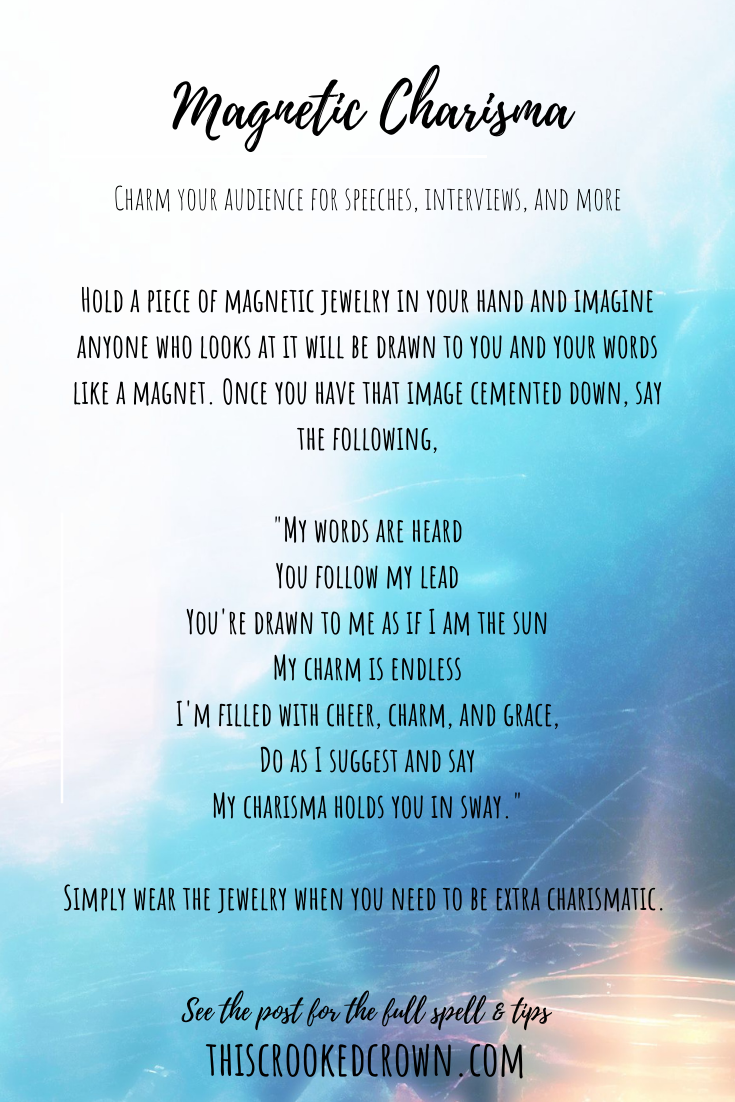
A spell to boost your charisma. It’s ideal for people that are making speeches or presentations, but it could also be excellent if you’re going for a job interview or something similar.
What you’ll need:
A magnetic piece of jewelry
Hold the magnetic jewelry in your hand and imagine anyone who looks at it will be drawn to you and your words like a magnet. Once you have that image cemented down, say the following,
"My words are heardYou follow my leadYou're drawn to me as if I am the sunMy charm is endlessI'm filled with cheer, charm, and grace,Do as I suggest and sayMy charisma holds you in sway."
Simply wear the jewelry when you need to be extra charismatic.
Notes:
Magnetic jewelry can take any form, such as a bracelet, necklace, rings, anklets, earrings, cufflinks, shoelaces, sunglasses, tie clips or tacks, etc. Magnetic ties, shoes, or other pieces of clothing would also be fine.
You can alternatively use magnetic therapy sport wraps or anything else magnetic that would be visible to the audience.
A simple refrigerator magic would work, but it should be visible to your audience.



 This Crooked Crown