Witchcraft 101: Adapting Spells

It’s a rare magical practitioner that hasn’t had to adapt a spell at one time or another. Usually it’s for personal practice reasons or ingredient reasons, but it can simply be that it’s too cold to walk outside or they just don’t like the spell’s steps or wording.

Adapting spells can be really easy – but it can be a challenge too. It’s okay if it’s a challenging or daunting task for you! It really is. Spell casting is a lot like cooking and baking; for some people, it’s easy to moderately okay and for others, it’s a daunting task.

Cooking and baking are relatively subjective. Things need to turn out a certain way to be properly edible and taste good, but not everything is going to taste great to the same people. Spells are a lot like that. There are some things that just won’t work quite as well for you as for others and some ingredients (like some foods) that you just don’t want to work with.

Like a recipe, there’s a way of approaching a spell that you need to adapt. Here’s how.

Step One: Read & Analyze

Read through the spell completely, including any notes the author or other practitioners may have made. Take notes yourself as needed, marking what things you’d need to purchase or procure in some manner. Also know any timing events that need to be marked on your calendar (such as the next full moon).

If you plan on making any adaptations, write it down clearly. You’re swapping this ingredient for that. If you don’t know what ingredient to swap something for, then you need to really sit down and analyze that spell. What purpose does that ingredient serve in the spell? If you can’t see an obvious reason, it’s probably best to assume it’s there for a correspondence reason. To help with that, check out correspondence charts.

How this compares to a recipe: When you make a new dish, it’s always a good idea to read through the recipe. It may need a special pan you don’t have or an ingredient that’s not listed in the ingredient list above. It may need the butter or eggs to be room temperature or it could be the baking is thrown off on cold days. There may be a reason that ingredient is specific to the recipe – without it, the puff pastry won’t rise or the chemical reaction you need for the yum factor doesn’t happen. Research helps mitigate this before you’re elbows deep in ingredients and realize you’re up a creek without a paddle and a storm is brewing on the horizon.

Step Two: Double check that you have everything

There’s little reason to try a spell or recipe when you’re missing half the stuff – it’s not the same thing at that point. You may be able to create something wonderful, but it’s a brand new spell or recipe. Not the same thing. That’s not a bad thing! Just make sure you write it down. But if you’re intention is to cast a specific spell, be cautious of exchanging too many ingredients or you’ll wind up with something different than the original intention.

That being said, I’m firmly in the camp of winging it. If you want to try and spell and need to adapt it, do it. Take notes on what you’ve changed (in case it works better than the original spell or goes terribly wrong), but try it anyway.

Step Three: Make your changes

Now’s the time for the adaptations. You’ve taken your notes and you have a good idea of what you want to do. Now to make the changes.

The first stop in adaptations is to a correspondence chart or list of some kind. I have one available here, which is sourced and ever-growing.

Sometimes swapping an item can be easy. You need something to represent luck, well, here’s four other herbs that do exactly that. When things have symbolic meanings or magical correspondences, they can often be easily swapped.

But not always. If you really want to be diligent, a quick google search with the ingredient plus something like “folklore” or “magical correspondence” can lead you to why that ingredient is considered lucky. This may be critical at times. Sure, an herb might be lucky, but only for gamblers. That isn’t going to help too much when you want luck taking an exam.

You also have to be aware of herbal associations. Some spells, especially the edible kind, have herbal combinations meant to do something actually physical to the body. It’s not symbolic in meaning, but science. So you can’t just swap in something with a magical correspondence when the concoction is herbal medicine in nature. Plus, herbs can be dangerous – they can counter to one another, they can react with medication or current medical conditions, and they can be toxic. So you have to be very careful when doing something that’s meant to be consumed.

Now for some people, they stay away from herbalism and stick with magical correspondences only. That’s perfectly okay! But be aware that many herbal connections come from herbalism. Even the weird ones. So knowing why something has that association may be important.

And none of that may matter at all. People can work intuitively with ingredients and make up their own correspondences and associations. That’s a great way to go about it too.

You also have to consider the purpose of the item in the spell. Swapping a red candle for a white one is easy since white is seen as a universal color or something of a blank slate. But when you start thinking, “well, I don’t think this makes a good candle spell. What if I skip the candle?” And for some spells, you can absolutely do that. The candle is superficial or is being used as a focus object (ie, something to look at and hold) For others, the candle is being used as a conduit (ie, the spell verse might have “as this candle burns”) or the candle has a practical purpose (ie, burning a piece of paper with writing on it). It’s harder to swap out items that are practical or are a conduit.

In short, there can be more to adaptations than just “this is the ingredient on the list that I have”.

Step Four: Do the spell

Go for it. Just try the spell. When you’re casting, you may need to change things up on the fly. Maybe the candle won’t stay lit or your neighbor is being nosy. Maybe the dog starts barking because she needs to pee or your phone goes off non-stop with notifications. Sometimes the wording is just plain weird and doesn’t work for you.

Adapting on the fly happens. Finish the spell. Even if you lose momentum or the build up of energy. Even if you feel rushed, judged, or things get weird. Finish your spell. Not finishing it can lead to weirdness and energy drains, at the least.

Use the words that work best clearly for you. Yeah, that old timey wording looks great, but if you’re not feeling it, use your plain ol’ normal words instead. Speak or think honestly and clearly when you need to make wording changes.

Step Five: Record

You’ve been taking notes all along. Now record what happened. How’d the spell casting go? Over the next few days and weeks, you’ll probably begin to see results. What are they? How do they meet your expectations? Do you think your adaptations changed how the spell worked?

As you progress with your practice, you may find that you don’t want to, need to, or like to write things down. I’ll be honest, as someone who spends a LOT of my time writing, I rarely write down the spells I routinely do or do off the cuff unless it’s really good. Mostly, I write down stuff I’m tinkering with. That’s my personal preference. You don’t need to have meticulous records, but they very much help.

I know a lot of this advice sounds like “just write it down!” and, honestly, keeping notes as a beginner can be really key. I am well-known for winging it in just about all my personal spells, but I take notes for myself on spells I’m working on. It can really help, especially when you’re doing an important working or you’re making adaptations.

Hope that helps! Happy casting!


Patreon | thiscrookedcrown.com

Advertisements
Advertisements
Advertisements
Advertisements
Advertisements


6 Tips for New Witches

Starting as a new witch is always hard, but the internet can make it really hard. Who do you trust? What should you focus on? Do you really need that $50 cauldron or those 80 herbs?

The truth is that no one’s going to have exactly the same experience. What your interests and passions are, who you are, and what you connect with on a personal and spiritual level all alter how you perceive even basic witchcraft information and that alters your path. You’re unique and so will be your magical practice. And that’s a good thing!

Still, it can be hard to get a good foundation and know where to begin. So here’s my top six tips for new witches.

01 Research Can Be Key – But It’s Not Everything

Spending time researching and reading various occult topics is really important as a new practitioner. Not only is there probably a lot to learn, but you can discover your new path and new opinions that way.

I find a lot of unique and interesting things about my own practices comes from research (and later experimentation). Research can show you new areas to explore and new things to learn. It can help you create a path that will stay with you for a lifetime. It can lead you to friends, coven members, or even life partners. It all starts with research.

That being said, research isn’t everything. Sometimes, you just have to close your eyes and follow your intuition. Sometimes you just have to take that instinctual leap. Sometimes, you just have to push up your sleeves and just try a spell.

Following your intuition and giving something a try can lead to wonderful, magical moments. It can make you really believe in magic.

It can also teach you a lot too. You may quickly learn that you dislike divination or verbal spells. Maybe you’ll go back to study those later, but for now, that dislike’s important information! It means that you should shift your focus away to something you do like for now. Come back to those dislikes later. Maybe the knowledge you’ll have learned since then will help you understand why you disliked it in the first place or maybe you’ll find that you still dislike it. Shelf it and come back later.

TL; DR: Read everything, but don’t forget to follow your intuition and passions. And use your public library!

02 You Don’t Need Everything

You know those lists of stuff you have that so-and-so blogger says are a must have or whats-their-face author swears you need? Yeah, skip it. At least at first.

If you’re getting into witchcraft I recommend just five things:

  1. White tealight candles + lighter
  2. A stoneware cereal bowl (plain black, plain white, or clear preferred)
  3. A jar with tight closing lid (jam jars are great)
  4. Thread or ribbon (your color preference)
  5. Plain paper + smooth rolling pen

With all of that, you can do just about any spell. Seriously. And those items can be cheaply gathered from what you have in your house already or purchased cheaply.

Bonus tip: Don’t rush out to buy herbs. Use what’s in your kitchen first. Add slowly and in small amounts. An ounce seems really small, but it’ll probably last you for a year for most herbs. You usually just need a bit for a spell.

03 Write Down Your Experiences

I am weirdly awful at recording stuff for myself. I always recommend it for others, but I almost never do it for myself. But! There are many times I’ve made a spell at a drop of the hat and wished I wrote it down because it worked great but I have no idea what I did so I can’t replicate it.

Even something as simple as a notebook with “I did X, Y, and Z” could help. Use a journaling app, post about it, or email it to yourself.

For those looking for more elaborate set-ups, there are lots of spell recording layouts out there. Just google or spend some time on pinterest.

04 Someone Else’s Practice Is Not Better Than Yours

There are a lot of people out there practicing spiritual or magical paths. And many of them post about it. Those altar pictures might be beautiful and they may have had a great experience with the deity your worship. Maybe they just have a gorgeous spell casting area or a meditation corner.

The thing is this: you can absolutely admire their practice. You can say “wow, it’s great that they’re having those experiences”. But those practices might not be yours to have. Cultural appropriate weighs in here heavily, but you also have to consider this: are you really going to change your whole practice and what drew you to practicing to begin with because someone has beautiful instagram photos?

There’s also no guarantee that what that person is post about is all that practice is. Sure, maybe the water goblet is used as a water element representative, but it might have another purpose that’s special to that person. You may be missing the point behind the prettiness of the scene.

And, real talk, they may be just taking pretty pictures. They might have spent hours to get the altar to look pretty just for those photos and spent five minutes lighting a candle and saying “hey, thanks”. Or they are lying about the experiences they have. People do lie within the community about their experiences, mostly for attention reasons. I have a policy: I believe people are experiencing what they say they are experiencing. I don’t doubt them. But I also know that those experiences aren’t any less valid or any less true than anything I’ve experienced. This policy allows me to live and let live, essentially.

You can want that beauty and experiences for yourself. Be a little jealous or sad that your practice isn’t as pretty or you’ve having great experiences. But let those things drive you to do better for your practice. Ask yourself if you’re changing things because they have meaning to you or if it’s just because you really want it to be beautiful. You can have beautiful things in your practice and they can be there for just the pretty factor. Just make sure that you aren’t altering things to having all beauty and no substance.

05 It’s Okay To Not Like The Popular Thing

So you tried that awesome tarot deck that everyone loves… and you didn’t like it. The art’s too dark or the devil card scared you or you just don’t like tarot card reading. That’s okay!

Sometimes we get stuff because we fall into the hype or we thought we’d use it and we didn’t. Or our practices changes and we don’t need it. When that happens, it’s okay to grieve a little that it didn’t work like you wanted it to. Then let it go. Give it away, sell it, donate it, etc.

You don’t need to hold onto things because everyone’s loving how deep and meaningful it is. If it doesn’t work for you, then it doesn’t work.

We change as people change. And so do our practices. It happens, sometimes very slowly over months and years. Sometimes it happens quickly because of events, trauma, or revelations.

Don’t be afraid to let your practice grow organically. If something’s working, then keep doing it. But don’t be afraid to set aside practices that no longer work for you.

06 Use Your Local Library

Your local library is a literal lifesaver, especially when you’re just starting out. I have bought books because I loved reading it. I have not bought books because they weren’t as good as I was hoping or the subject wasn’t covered as well as I’d like. I’ve been able to research a lot of stuff that would cost hundreds of dollars to research without it. I’ve sometimes saved that much by borrowing a single rare book alone. (Yes, seriously)

Not only can it save you a lot of money, it can also spare you from buying books that you won’t use or don’t like. Maybe you’ll find out that you really don’t like that popular author. Or that you’re not a fan of how this mythology book writes about goddesses. Just because something’s published, doesn’t mean it’s good. And not every book out there is something that you’ll want to re-read. Borrow the book, read it, and return it. And many times you can request a book from another library through the intra-loan system and have it delivered to your local library.

Many libraries also have a digital library where you can borrow e-books to read. Many times you can find the e-book, but not the physical book in your local library. Not only does this mean you can read it on the go, but no one sees when you borrow a book. It’s on your library record, but that’s all.

What else can your library do? A LOT. Here’s my local library as an example:

  • Free wifi with tables and chairs in various spots for privacy
  • Borrow movies – some even digitally – for free. Some libraries allow you to borrow music.
  • Public computers, free to use.
  • Print and fax machines, with a low fee.
  • Public notary
  • Meeting rooms for community events. Some libraries may allow these for private clubs or groups.
  • Free to borrow passes to museums, zoos, aquariums, and more.
  • Hosts free talks, lectures, and classes on many different subjects, including local wildlife, gardening, cooking, art, night sky viewing, crystals, reiki, history, and more. This month had geocaching, making a corded bracelet, a fairy house, outdoor photography, instant pot demo, vision board making, making a journal from scratch, bullet journal 101, four cooking classes, how to properly use a telescope, and basic info on Iceland and traveling there.
  • Free indoor and outdoor concerts from local musicians and well-known folk musicians.
  • Free art exhibits from local artists.
  • Free events such as passport processing, public paper shredding, movie showings, and similar.
  • Free trivia nights, including Harry Potter specific trivia nights.
  • Weekly clubs for teenagers and adults, including writing, journalling, knitting & crochet, quilting, and book clubs.
  • Weekly classes, including adult art class and children’s coding classes
  • Weekly English as a second language classes, including the requirements for citizenship
  • Weekly homework help or tutoring
  • Weekly computer and technology help, including help for using things like apps
  • Seasonal weekly farmer’s market with outdoor concerts and events.
  • Access to academic journals, digital magazines, online computer websites such as genealogy websites.
  • Online classes, including foreign language classes.
  • Locally published books found no where else on local areas (Key for local superstitions and folklore).
  • Public 3D printer
  • Private recording studio (you just need to book an appointment)
  • I can borrow a telescope to take home for a week
  • I can sign up a raised garden bed in the community garden

And that’s just the adult and teen stuff. For kids, there’s twice as many classes and events, including giant lego blocks, storytime, reading to animals, and more. Some libraries will even deliver books to you in a homebound program, allowing the elderly and disabled to use the library fully.

Given, my city is a small-to-medium sized city with only two libraries and a learning center. My friend lives a few towns over and their library has a mini museum, a full outdoor playground, borrows cake pans and fishing poles, and the elderly can request books or audio tapes and get them delivered at the nursing home. Each library is different, so check and see what your library is doing.

Also, I’ve never been to a library where I need to flash my library card to get in the door. You can probably walk into any town’s library and read their books. You just can’t borrow those books.

Use your library. I can’t stress it enough. The more you use it, the better for everyone.

That’s it! I know some of these seem kind of basic, but really, it’s okay just to take things slow and let them happen as they happen.


Patreon | thiscrookedcrown.com

Advertisements
Advertisements
Advertisements
Advertisements
Advertisements


Heat Magic

Heat magic is a form of magic using heat as a conductor of or influence to spells. In short, it’s hot as balls, so might as well cast some spells.

Heat magic is, for real, any time you work magic invoking or using heat as an element within the spell or working. So if you’re using the heat of a flame in a spell, that’s both heat and fire magic. It can be really useful, which I’ll talk about a bit later.

First, let’s talk about heat, in general. (Warning for casual and probably ill-explained science ahead). When we’re talking about how hot it is for our bodies in regards to the weather, we’re actually not just referring to the temperature. I mean, yes, we do say “how hot is it out there?” And we know from the number thrown at us that it’s hot. But, heat doesn’t exist alone, so there’s some other things you need to calculate.

We also need to factor in the sun’s brightness (because standing in bright sunlight is nice for about 5 seconds until it’s not) You also need to calculate the wind’s strength and where that wind’s coming from and how hot the wind is (because hot, stale wind on your face is just gross is like the earth’s breathing on you.)

You also need to add in the most important thing: the humidity amount. Humidity affects humans because we cool our bodies by condensation (we sweat). When it’s hot and dry, the water joins the air and goes on a wonderful journey that is Somewhere Else beyond your body and you’d care more if it wasn’t so bloody hot. That doesn’t happen when the humidity is high. When the humidity is high, there’s so much water grossness in the air, it’s like a swamp. Seriously, imagine a swamp – that’s what the air is when it’s humid out. It can make a cooler temperature in general, so much more miserable and hot, because there’s so much humidity in the air.

Additionally, one must remember that we acclimate to our regions and environments. So while someone in South Cali is like “110 today? Huh, it was hotter yesterday” and sneers at someone in New York is complaining about the 90 degrees in their area, one must remember that 1) the regional weather is not the same, so it might actually feel like 110 in New York, even if the weather app says otherwise. 2) While it might be normal for South Cali to experience that kind of heat, but it may not be in New York. People aren’t prepared for unusual weather patterns in their regions. This is why, when it snows in Florida, people lose their damn minds. And 3) people have different needs and therefore some people get more uncomfortable in certain kinds of weather than other people. And 4) that mocking people for complaining about the weather, a thing we all experience, is pretty fucking shitty among strangers on the internet. So let’s ease up people.

(By the way, all of the above, also hold true for cold temperatures. Just an FYI).

How you imagine heat will change depending on what kind of heat you’re accustom to. In Rhode Island, we have high humidity regularly pretty much all year long. It often rains and the humidity  stays right where it is, which is a kick in the teeth, let me tell you. It’s like “oh, it might rain today! Yay!” Thunderstorms rolls in for forty minutes, spitting warm water at you, then rolls out. “Oh, it made no difference at all, except it’s wet now. ” It’s fun.

When I imagine heat, I imagine it in three ways. Heat from fire and ovens, which is smoldering and directionally hot. Another is from heat in general, like standing in the sun and soaking in that warmth like a cat. The third is humid warmth where everything is a hot soupy swamp and no amount of iced coffee can help it.

Depending on your goal, pick a day embodied by your form of heat magic. Healing spells I’ll use sunny days, but I’ll reserve high humidity days for curses or spells that need extra energy.

Why heat magic? Well, it’s as natural as it comes. It’s a form of nature and weather. Controlling fire is one of the key discoveries of humankind, so working with fire magic is a good way to connect to older energies or ancestor worship. It’s also super low-key and needs no tools. You don’t need a cup of water like you might with water magic or a handful of dirt like in earth magic. You just need to open a window or step outside. (And then be miserable because HOT). It’s also a good way to work regionally within your practice, because your weather is localized to your direct environment.

Heat magic can be used in the same way you might use magic during a storm. You can simply cast the spell on the heat-soaked day. You can also use the heat as an ingredient, by “capturing” the heat in a jar (it will literally be a jar of air). It can be invoked (IE “by the heat of the day”.  It can be directed, like opening up an oven, and saying your spell with the heat blasting your face.

There’s lots of ways heat magic can be useful. You might have already given heat magic a try, by using the heat from a candle in a spell. If you haven’t, see what kind of spells you can come up with that might use heat magic. Who knows, you may find a new favorite spell medium and if not, at least you’ll have something else to do when it’s too hot to move or care.

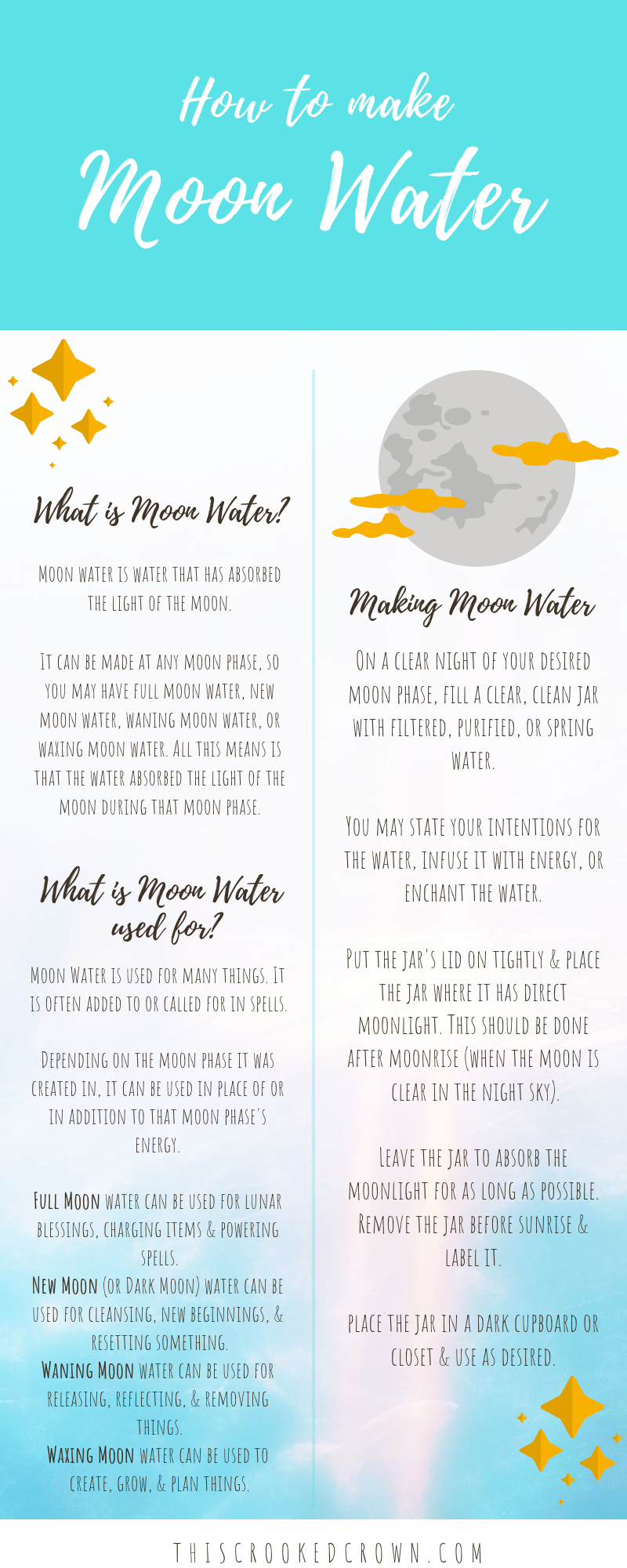
How to Make Moon Water

Bringing things back to basics with a how to make moon water. I know this seems like a pretty obvious thing to some folks, but I often get messages asking me what this ingredient is or what that ingredient does. Ingredients many practitioners consider very basic, like full moon water.

First, let’s cover what full moon water is. Moon water is water that has absorbed the light of a moon. This can be any moon phase at all. Usually though, when people refer to moon water, they’re referring to full moon water.

As you might guess, full moon water is water that has absorbed the light of a full moon. New moon water is water that has absorbed the light (or lack thereof) of the new moon. Waning and waxing moon water can also be used.

Now there are some variations of names here and some additives to take into account. I’ve seen people refer to new moon water as starlight water because without the moon, it’s really water just gaining starlight. it’s also called dark moon water, because the new moon is sometimes called the dark moon.

People also will divide the moon water up further by including and calculating out the astrological and planetary positions. I don’t have much to do with astrology, not my field of expertise, so I tend to mark the data down, but I rarely do anything with it beyond grabbing a jar marked “full moon water”.

There’s also some variation on how to actually make full moon water. what you actually need is water. But the type of water matters to some people. Others add intent to the water. Other people add crystals, herbs, salt, and so on.

Truth be told, adding these things tends to make it no longer just moon water. Adding a crystal in the water really makes it a moon water gem elixir and adding herbs in the water is just a herbal infusion. But if that’s how you want to make your moon water, then go for it! Just know that most spells aren’t referring to anything other than water that has absorbed the moon.

Ready for the recipe?

Ingredients:

  • Water, any kind. Purified, spring, bottled, filtered, or tap.
  • A clear jar with sealing lid
  • A paint marker, any color or label
  • A clear, cloudless night during the full moon

First, make sure your jar and lid are clean.

Next, pour your water into the jar and cap it. You can enchant the water, put some intent in there (such as matching the intents to what the moon phase tends to represent), or you can say nothing at all.

Place the jar in a window or outside where it will be in clear sight of the moon. This should be done after moon rise (so, pretty much as soon as you can see the moon and after the sun has set).

You can leave the jar out there as long as you’d like, but try to take it back inside before sunrise.

Label the jar by writing on the jar with the paint marker or using a pre-made label. The label should at least read “full moon water” (or whatever phase the moon is at), but you might also want to add a location, date, weather, and so on to your label.

Place the jar somewhere dark without sunlight, like a closet or cupboard. use the full moon water in spells, to anoint items for more power, abundance, happiness, to bless something with lunar energy, or to charge an item.

If you’re making any other type of moon water, this above also applies, just do it on a clear night where the moon is in the right phase.

I even made you a little pinterest how to for you all. Easier to reference, for sure. Hope this helps!

3 Ways to Magically Reclaim Yourself

Ever been lost in the sea of yourself? You just feel restless and confused and sad. Hopeless yet desperate to move forward. Hoping to find something that will help you keep your head above water yet finding yourself anchored with no where to go.

It’s a crappy feeling. When you spend several weeks, months, or years with barren fields, so to speak, it’s called a fallow time. This can happen to anyone about anything. It happens to artisans (writer’s block, anyone?). It happens to businesses. It happens to spiritual paths. It just happens. Sometimes you need to let your live be boring and kind of crap so you can sow new seeds for a better future for yourself.

This can be exceptionally difficult however, when you’re dealing with spirituality or magic. How do you know you’ve even going the right way? You don’t and that’s extremely difficult to come to terms with when you just want direction.

So here’s a few ways to reclaim yourself and your path magically.

Find a quiet place that feels like home

This one is pretty simple. If there’s a place that you resonate with entirely, the ocean, the mountains, a park, your kitchen, your bed, then schedule yourself time to be there. You should make that location as ideal as possible and make sure that you aren’t disturbed for several hours.

Setting up the ideal situation may require some planning ahead. You may wish to aim for a day where the beach won’t be too crowded so you can enjoy swimming in the ocean without worrying about a beach ball bouncing off your head. Maybe you feel most happy with a batch of delicious bread baking and soup bubbling on the stove. You might need to wash all your bed linens and pull out some extra comfy ones you don’t normally use for this session. Essentially, what you’re doing is setting up as close to a perfect scenario as possible. You may need to clean up the space before you set up (so clear out the stack of crap that accumulated on your kitchen table), but it depends on what place is your happy place.

Distractions should be entirely limited. This means turn off your phone, computer, TV, and so on. Just turn them off. If you’ve never unplugged before, this can be extremely difficult to do. But try it for at least an hour. You may wish to play some music, and if so, make sure that it’s relatively inconvenient for you to scroll through instagram or facebook chat someone. Place the device out of range, with the notifications on silent, and just sink into the relative quiet.

Once you’ve gotten set up, just exist in that space for the time you’ve set aside. Read a book that feels inspiring to you (maybe it’s a big thinking kind of book or maybe you hauled out your Harry Potter to remind you why you love magic.) Swim in the ocean, lay in the grass and watch the clouds. People watch, read through family recipes, hike through the forests, slowly boat across a lake… you get the idea. Just exist in that space in a way that makes you feel relaxed and happy. Let your mind drift (it will) and soon you’ll find you may start connecting spiritually to the place, remembering why it feels so special to you. Recall what’s magically about that place and you may rediscover what’s magical about you.

Cutting the threads

This is spell work that asks you to have a fairly open space and time to set up the spell.

First, clear a space. If you’re casting the spell in the living room, you may need to put things on top of your coffee table away and move that side table you always trip on anyway out of the way entirely. You’re going to need space to move and you don’t want to be tripping on things when you don’t need to. You’ll want at least a five foot clear space, but I like to have a few feet extra all around for wiggle room.

Next, write out all the things that are holding you back. What things pull on you, weight you down, whispering unwanted things to you? What makes you feel muddy, sour, mundane, and dumb? Write all of that down on slips of paper (post its are perfect for this). Scatter these slips of paper across your casting space. It’s really ideal to place the paper on or near objects that symbolism or remind you of the words on the paper. (So if looking at your exercise bike makes you feel sloppy and guilty for not using it as often, put that piece of paper on the bike).

Get a ball of string. This can be any color you like, so use color symbolism. Tie a loop around your dominant wrist. It doesn’t need to be tight. Gently, go to each place you put the paper and wrap or tie the string around or near it as best you can and move onto the next paper.

I recommend doing this is the order of the things that come to mind. If you really dislike your job, that might be first, but your second item is you feel poorly whenever you see your aunt, then she might be next even if the photo of her with the slip of paper is all the way across the room.

Things will become a jumbled mess. That’s OK. It’s kind of meant to be. Just keep going until you’ve tagged all the pieces of paper. Once you do, gently tie your non-dominant wrist with the string.

Now grab a sharp pair of scissors or a knife and cut the strings that attach you to the items. You might need to make several cuts so that the string drops to the ground. Keep doing this until all the string is cut and CAREFULLY cut the string free of your wrists.

An alternative way to do the spell is to tie the string to your wrist, then to the object or paper, then back to your wrist, but this can become quite tight and painful in larger spaces as you tug the strings across the room with you. I think it kind of works better this way, because it feels more freeing and thus more powerful, but it’s more painful and tends to break at least one random glass thing you forgot you owned.

Either way, take the strings and burn them in a fire-safe vessel and call it a day.

Ask for a journey or trial

You can always as a spirit for advice. Usually people tap their spirit guides for this, but sometimes you need a stranger to give you advice. Other times they just keep telling you what you already know. Ask them again anyway.

If you don’t have a spirit guide or don’t want to use them, you can go find someone who can help. I wrote about spirits who can help, spirits I can personally vouch for as friendly and helpful. I like and visit these spirits often and the space is still considered quite safe for travelers and dreamers (ie, you) to wander through. The spirit ruler in particular is good for requesting a journey or trial, as they tend to be fully aware of just how much is lost between the astral and the physical realms when it comes to memory.

I know you’re thinking. That’s just getting advice. Well, the reason I make the above suggestion is because if you’re going to ask for a trial, you want it to be from someone who will give you a task that will give you the result you want: reclaiming yourself.

The trial may be something classic: “go here and get this item for me and you’ll be rewarded” but the actual reward is discovering yourself. It could be a battle scenario or dedicating yourself to their service. It depends. You don’t have to say yes to the suggested trial or journey. If it sounds sketchy, then don’t do it. But this gives you a chance for you to have an adventure that will help you find you again. Find yourself and your will once more without all the baggage that comes with living.

Those are just some of the ways to magically reclaim yourself. As always, I recommend cleansing yourself (and cleaning your space) when you’re struggling spiritually as sometimes the mere act of cleansing and cleaning can dissolve the spiritual gunk.

Good luck!

What Makes a Crossroads a Crossroads?

What Makes a Crossroads a Crossroads

Have you ever looked at a spell and it says something like “leave the object at a crossroads”? Many, many spells end this way and for good reason. Leaving an item at a crossroads magically and energetically disperses the energy. It’s good when you’re leaving a general offering for spirits. It’s great when you’re trying to cast a non-targeted spell.

Leaving spell work in specific places is usually because you don’t want it around. As said, sometimes it’s for safety’s sake (ie curses or spirits), but other times it’s for things like healing spells.

If you used a rock to remove a disease from somebody while healing them, you don’t want to keep that disease-ridden rock. So put it at a crossroad where it’s away from you.

Some witches leave things at the crossroads so others can pick it up and a curse can be passed that way. And some witches use it to bless those in the same manner.

It’s also commonly used in getting rid of spirits and curses. Capture a spirit and release it in a crossroads far away from your home. Toss the remains of the curse you’ve casted or the dregs of whatever uncrossing spell you’ve done to rid yourself of a curse. Both instances ask you to visit a crossroads far away from you home.

A third usage is an energy reset. This usually is used by a practitioner that does a lot of land-based or local magic or works with a lot of spirits. Sometimes, you just need to cleanse the energy lines and the space.


All of those things can be done at a crossroads. But what makes a crossroads a crossroads? What are the unspoken rules about crossroads? And why are there unspoken rules at all?

First, let’s establish what a crossroads is.

It’s an intersection. Or, rather, a crossroad is where two or more streets intersect or cross one another.

Properly, it should be any intersection where four streets meet and none of the roads are a dead end or cul-de-sac. However, train-tracks and roads, bridges, and so are are also crossroads and can be used, even if they are literal streets.

Plus, dead ends and cul-de-sacs can be useful in crossroad including spells – want to stop energy from spreading? Want to make a boundary within your neighborhood? Those kinds of spells could benefit from streets that end abruptly.

Similarly, a corpse road is a road that traditionally refers to the pathways or roads the dead were carried on from the church to the graveyards. Often, corpse roads were separate paths with gateways because of fear that the dead linger on such roads. Now-a-days, any road used to carry the dead from one place to another could be considered a corpse road.

I like to combine the two. My home, the Crossroads House, sits between two crossroads (literally two intersections) and is behind a funeral home. So my crossroads are corpse roads. However, if you don’t work with spirits, perhaps selecting crossroads that are not corpse roads is more beneficial to you. Weigh your choices carefully.

When it comes to symology and magical purposes, crossroads are well-known world-wide. I’ll quote from The Complete Dictionary of Symbols edited by Jack Tressider (pg 128-129):

The unknown – hazard, choice, destiny, supernatural powers. The important attached to intersecting ways in most ancient cultures is remarkable. The fact that they were natural stops for wayfarers only partially accounts for the number of shrines, altars, standing stones, chapels, or Calvaries sited there. In Peru and elsewhere pyramids were sometimes built up over years by travellers adding votive stones as they passed through crossroads. Spirits were thought to haunt them, hence they were sites for divination and sacrifice – and, by extension, places of the execution or burial or people or things of which society wished to be rid. Many African tribes dumped rubbish things there so that any residual harm might be adsorbed. Roman crossroads in the time of Augustus were protected by two lares campitales (tutelary deities of place). Offerings were made to them or to the god Janus and other protective divinities, who could look in all directions, such as Hermes, to whom three-headed statues were placed at Greek crossroads. Hekate, as a death goddess, was a more sinister presence, as was the supreme Toltec god, Tezcatlipoca, who challenged warriors at crossroads. Some version of the Oedipus myth placed his faithful encounters with his unknown father, and the Sphinx at crossroads – an analogy for destiny. Jung saw the crossroads as a maternal symbol of the union of opposites. More often, they seem an image of human fears and hopes at a moment of choice.

That’s a lot of words so I’ll break it down.

Crossroads have and will always be a symbol of choice. In the past (and even today) travel by the roads is pretty much the only way to go. In the past it was safer because other travelers can band together to protect one another. Today, property laws say you can’t trespass making roads pretty much the only way to travel.

Because people traveled on them shrines, altars, and holy places were erected at intersections. Sometimes even notes were left by signs. It was also a great place to meet people coming and going.

It was and is also a place where spirits dwell. Part of that is from the shrines, others is because of the executions. I see crossroads a bit like a spiritual water cooler. Spirits seem to collect there because of all the different energies coming from different directions (and be carried by different people and things).

Additionally, if you believe that energy travels via roads (whether naturally or through people passing on those roads), then crossroads are very magically powerful.

Because of the spiritual symbolism behind them, especially in regards to actual spirits, there’s a lot of unspoken rules about crossroads. Here’s a few of them.

Never use the same route home

This means if you came up the eastern road, you should use the western, southern, or northern route home. Don’t use the eastern. This is because a spirit or energy could follow you home through the circuit you’ve made. Instead, take a different way home, which should spiritually or energetically get them of your trail.

Never respond to voices at the crossroads

Sometimes, you’re at a crossroads and you may here people talking. Logically, this is because crossroads tend to be open spaces and voices travel. However, it may also be spirits or faeries. In any case, don’t respond to the voices you’ve heard. Just go about your business and be on your way.

Do not make deals at the crossroads

This follows the above rule a bit further. If you go to the crossroads and see another person there, then keep on going. Don’t stop to talk with them, don’t stop to do your work, and don’t turn around and go back the way you came. Don’t meet their eyes and, above all, do not make deals. Simply put, there’s a strong belief that if you meet another person at the crossroads, it’s probably going to be a faerie, spirit, demon, or even the Devil, depending on who you ask. It’s Bad News. Skip the drama and don’t even stop.

Never leave items with your address or name at the crossroads

This is not only for spiritual safety, but your physical safety. Someone could simply google you and cause all sorts of problems. Spiritually, offering your real name to spirits, other practitioners, etc is often questionable. Your name is a piece of you. Guard it.

Try to leave environmentally safe items at the crossroads

This isn’t a rule, but it should be. Often times, we leave leftovers of spell work and other things at the crossroads. Typically speaking, it gets cleaned up when the city comes by or neighbors. But animals and the less fortunate also use or consume what they find at the crossroads. So if you’re going to leave an item that is not for consumption (like sugary bread baked with glass for a curse) then bury it at the crossroads. You may need to search for a crossroads that you can discreetly dig at, but it’s worth the trouble to keep animals or people from consuming unsafe things. This is also true for jar spells. Consider, does it really need to be in a glass jar?


I use crossroads fairly extensively in my craft, when it calls for it. But I’ve been asked what a crossroad is about a dozen times a year, so it was time to type up my thoughts about it.

Crossroads certainly have their place in magical practices. It has it’s place in folklore. It’s certainly a symbolic feature and we use it often in media to describe being torn or in many places. Remembering this folklore and symbolism is important, but you’ll also want to take into account your own practices to see if crossroads fit your practice.


Post includes an original tumblr post.

Pop Culture Spells Are Real Spells

I’m sure you’ve heard it before. “That’s not a real spell” or “You can’t use that spell from Charmed” or my personal favorite “You need to use a spell from a real spell book not one that you made up or stole from TV.”

Some of my followers are laughing. You should be. The sad part is I’ve actually been told these things by other witches. I’ve heard them from actual people actually saying and believing this.

So I’m going to say this straight: this kind of thinking is illogical, infuriating, and bullshit.

Candle Smoke

Someone had to write those spells. Even in your precious “real spell book” (whatever that means because what separates a spell book from other books except intent and instructions?). I’m not even going to touch the fact that some actually people believe you shouldn’t write your own spells (or that you need a particular skill level or talent for it). Nope, I’m not going there. But I will go to that place where I can rant about the other stuff.

I’ve used spells from all sorts of places. TV shows, movies, books, poetry, video games, songs, instrumental music, even humming. I’ve used it all. None of the spells have failed because they were written for a video game. None. If they failed it was because a) Turning into a dragon is a bit out of reach at the moment (but who knows in the future?) b) I didn’t actually put effort into the spell and/or was just fooling around c) I didn’t power or empower the spell properly (look, unicorn horn and dragon teeth are kind of hard to come by, OK?) d) spells sometimes fail.

Let me give some examples of the cool shit I’ve done with spells from media forms:

  • Hair support spell – TV, slightly altered to turn from a curse into something more useable on myself
  • Attraction spell – a mix up of two songs with selected and slightly altered verses.
  • Short-term construct (created familiar) – song, verbatim
  • Mirror scrying spell – children’s book
  • Curse – based on a curse from a spell book, re-adapted for my novel, then re-adapted to be less vicious and used in real life.
  • Protection spells – general idea used by thousands of media forms AND witches
  • Harvesting spell – humming
  • Blessing for the dead – movie
  • Water boiling – a play
  • Annual festival ritual opening – poems
  • Annual festival ritual closing – anime / manga
  • Healing spell – Disney movie
  • Faerie conversation opener / spell – video game

All of these, by the way, worked as they were intended to. All of these were used in the same year.

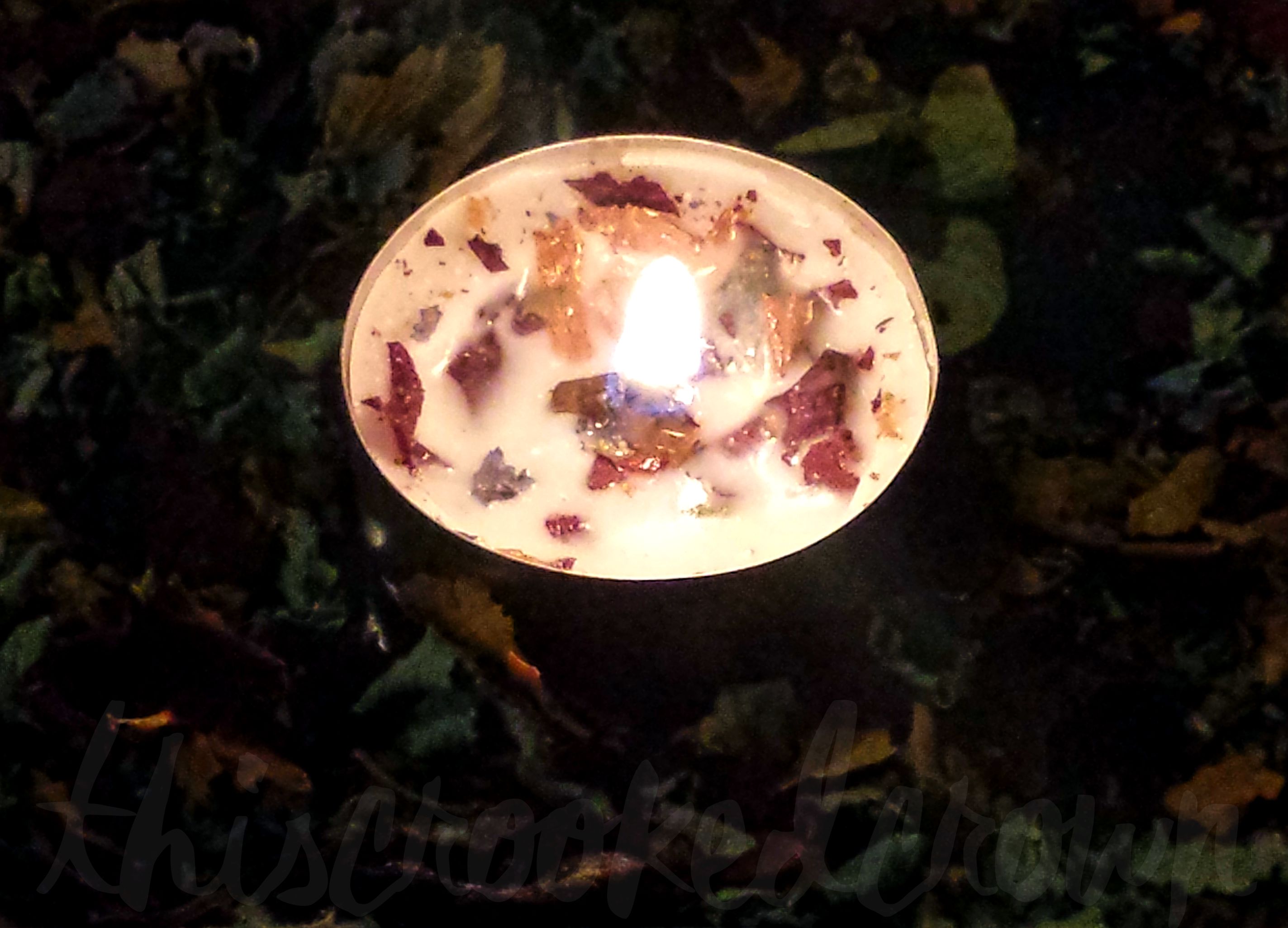
Spell and Herb Candle by This Crooked Crown

Why is a spell written for a video game is less… whatever than one written by a magical practitioner from a hundred years ago? Why are words of a dead person considered more valid? They aren’t casting the damn spell. You are. So it doesn’t really matter where the spell came from because you’re casting it. You. You can turn anything into a spell. Even humming.

(The only exception I’ll make is if the spell itself is a living spell that gains power the more you use it. But that’s the only exception and I’ve never actually seen a spell like that in any books or ever used as an argument so we’ll put that exception aside.)

I really don’t understand the logic of a person who says “that’s not a real spell”. When they are asked to explain why that example isn’t a real spell they never say “because there’s no vocalizations, so it’s really just a working” (which, in my opinion, would be a valid argument and then the word choices would change for the rest of the discussion appropriately). They never say that. They just say “you can’t use a spell from Final Fantasy! You just can’t.” When asked to further explain, they’ll simply keep saying “Because it’s not a real spell.” It’s a circle of fallacy.

What people mean when they say something’s not a real spell is that it was not written by a practitioner for a practitioner to be used as a spell. That’s what they’re saying. And that’s bullshit. It’s also poisonous thinking.

No spell is valid until you do the spell and verify it for yourself. I don’t care that Sparkly Pony Butt the Greatest Witch There Is says the spell works. You. Didn’t. Do. The. Spell. If you didn’t test it, then there’s no it’ll work just because Sparkly Pony Butt says so. If you do the spell and it does work? Great! Even if the spell doesn’t work, that doesn’t mean the spell still isn’t valid just because it didn’t work for you. You are one person. You can’t invalidate an entire body of work just because it didn’t work for you. You might not like Game of Thrones but that doesn’t mean it isn’t valid entertainment to other people, right?

For All Sorts of Money Powder by This Crooked Crown

On that idea, you can’t invalidate a spell from some media form just because it was written for a character. The character used it, didn’t they? The spell most likely worked for them too. So… why can’t it work for you? What? Because magic is different from their fictional world? The results might be less flashy and different but you’ll probably still get results. Using media forms for spells is brilliant. I’ll give you some example:

You broke up with your now ex-lover. You really still hate that asshole. They cheated on you, kicked your dog, shit in your cornflakes, called your art ugly, whatever. You want to curse them. Your ex-lover once charmed you by reading their favorite poem to you. Use that poem against them. Curse them by turning that poem into a weapon. Don’t change the words, change the intent of the words. Make it so every time that ex-lover utters a line from that poem they become entangled further in the curse. Make it so their shoelaces are never tied, their bread will always spoil, they’ll develop an uncontrollable bladder, or they’ll feel your heartbreak every time they read that poem. Every. Time.

Another example: You ran across an amazing healing spell in a video game. It is literally the most beautiful thing you’ve read and it strikes you in ways you can’t quite articulate. Use it. You feel a connection to it. That person you’re healing doesn’t care where you’re getting that spell from. All they care about is their flu going elsewhere.

Example Three: You’re watching Doctor Who and the Doctor said something that struck a cord. After thinking about it a little, you realize you can make it a spell. You’re excited and tell your Whovian friend who says you can’t use it (the the snarkiest way possible). The Doctor doesn’t believe in magic and blah blah blah. Now you’re a little heartbroken. Re-watch a couple of your favorite episodes (I’d avoid Doomsday) and do it anyway. Also yes, your Sonic Screwdriver can be your wand. Ignore anyone who says otherwise.

Example Four: Harry Potter. Use it. Love it. Ignore assholes who make snide comments. They aren’t on the Quidditch team and they’re just jealous. Seriously though, Harry Potter is often cited as an inspiration for many. Some of you probably came to magical practices from Harry Potter. Why shouldn’t a spell from the series be used as well? You might not be able to make something float as well as Hermoine, but you could probably use Wingardium Leviosa to lighten a heavy bag or box.

Pop Culture Spells Are REAL Spells by This Crooked Crown

Words are just words until they are given meaning. Given intent. We are the ones that ascribe emotional meaning and intent to words. Because words are just words, you can give them any intent you want. Turn that blessing into a curse, if you want to. It doesn’t matter what others say. Your spells are valid for you. They don’t need to work for anyone else. They just need to work for you. Tweak that song verse to fit your desires. Make it your own. And use it.

You’re a witch. Manipulating shit to our wishes is what we do.


Adapted from my original tumblr post here.

7 Tips to Get Your Life Under Control So You Can Get Back to the Magic

We’re all busy, right? We’ve all got a ton of things on our minds and it gets to be so hard to keep track of stuff. It’s even harder to fit in spiritual practices and make time for witchcraft.

I recently experienced this myself. I took on a lot of projects for This Crooked Crown on top of some personal projects for my own practice. Then Life reared its head. Family needed medical procedures or were sick (everyone’s OK! No worries), birthdays kept on coming, and the upcoming spring’s always a busy time with the ongoing Secret Future Plan project we’ve got going. Plus there’s the regular stuff to do too – readings, writing posts, taking photos, answering questions, and so on. There’s just a lot of stuff happening. I couldn’t keep up. It happens. Who’s got energy to cast a spell when you’ve been go-go-go all day?

I started going to bed with stress headaches and woke up with them too. That’s when I decided enough was enough and I was going to start managing my shit better. Here’s what I did.

7 Tips to Get Your Life Under Control So You Can Get Back to the Magic

01 Write down everything you’ve got going on 

This is absolutely the number one thing I recommend. It really drives home how busy you are and lets you see what’s happening so you can start prioritizing better. You may even decide to put something on hold for a while until some other project or situation can be finalized before taking up the reins again.

I wrote down everything I was thinking, doing, and feeling. It included little stuff like a mobile game I super enjoy playing daily to big years long projects that move slowly but surely. I also included stuff like stress about politics, birthdays, and personal worries or frustrations.

Then I numbered them three times. The first time, I numbered how important they were to me. This is kind of eye opening. You’ll really begin to see what’s important to you right now. Then I numbered them according to due dates – what needs to be done when – so bills or shop orders. The final time, I numbered them in order of priority to me or others I actually care about – a friend’s birthday, for example, might be more important to me than some due date for a thing I don’t really want to do.

Now do a comparison of the numbers. You can get as mathy as you’d like with this and figure out averages or whatever. I kind of just looked for similar numbers. If I listed a lack of spiritual connectivity as personal importance to as five but on the priority/due dates they were eleven or twelve, then that’s an area I need to focus on temporarily to feel personally satisfied but not dive into a major project for. So I might do a longer meditation session to help balance that out and get some more immediate results.

Make sure you look at how important stuff is to you and how you rate it as a priority. It might be that you’re ignoring your health or self-care in order to get shit done. it could also be that you want to accomplish something because you’re excited about it but it’s not actually all that important. Could your attention and energy be spent elsewhere or do you want to follow that excitement and allocate whatever time and energy you have left after you do that?

Also look at what numbers keep coming up or coincide with those items, especially if you’re into numerology. See if there’s a correlation with your divination readings in what cards keep coming up or if there’s some numerical importance attached to those numbers. Look at numbers that have huge discrepancies – or items you forgot to number. Those things may need some attention.

Now go through that list one last time and number how you want to proceed, taking in all that data. Using those numbers, write out a to do list with at least one actionable step you can take to start on that immediately. So if a birthday is your number one concern, write something like “research birthday gift” or “go out on Tuesday and buy present”.

It’s kind of a pain but this process can be really eye opening, especially if you remember to include things that aren’t just your daily to do or mundane but spiritual stuff as well. Maybe replacing that broken altar bowl doesn’t seem important but it might be weighing on your mind more than you know.

How to make this magic: Honestly, this technique is pretty eye-opening. I would use magical ink or paper or a language to write the list one last time in order of how you want to proceed, like a to do list, to ensure that you can accomplish what you want to accomplish.


02 Turned off the electronics early

I’ll be honest. I’m definitely one of those “turn off tablet/phone/computer/TV, roll over, go to sleep” kind of people. I don’t necessarily want to be. In a dream world and life, I wouldn’t even have a TV or computer in my bedroom. But since this isn’t a dream world, I have a ton of electronics in my sleeping area. And it’s a bummer.

Once I started going to bed with stress headaches – and waking up with them, I immediately stopped using electronics actively before going to sleep. Instead, I turned everything off but my tablet and read an fiction-based e-book until I found a physical book I wanted to read. I still woke up with stress headaches but I felt immediately less stressed and slept better.

There’s some scientific data to back this up but I know personally that turning my brain off from TV and instead letting my brain imagine stories before going to bed is better for me personally. Also look into blue light filters. I noticed my eyes hurt far less when I use blue light filters at nighttime.

It’s hard, I know. But give turning off your electronics ten minutes before you go to sleep a try.

How to make this magic: Putting sigils on your phone case for energy boosting is a great idea during the day to give both you and the phone a helping hand. Removing that phone from your hand at night allows you to have less energy and, thus, sleep much easier.

Aroma stimulation may also be useful. For example, I know it’s “no electronics time” and/or bedtime when I use lavender scented products. For me, lavender is used for quiet time. You might have a different scent that triggers this so do a little research to figure your own “shut off” scent.


03 Changed your rooms’ atmosphere and energy

Our rooms have their own atmospheres and energy. Right now, I’ve stacks and stacks of books everywhere for research projects. It reminds me of my college days where I was super stressed and sick all the time. Once I identified that as a contributing factor, I swapped out some things to shift the room’s energy – and my associations – to something else.

I picked fire, wind, and light as an energy to focus on. I used citrus scents, made sure to work in brightly lite rooms, and put on wind and bell soundscapes. My stressful associations shifted away and I felt far more productive and accomplished.

I also changed out my bedding, picked up lightly about the room, and rotated some decorative pillows and throw blankets to give a subtle change. I also throw open a window for a little while to air the place out.

As a bonus, changing up the lighting, scents, and sounds can immediately affect your mood.

How to make this magic: Color symbolism helps here, but so do scents and so on. Magical correspondences are your friend here. Ringing a bell can also dissipate clustered energies.


04 Dressed to boost your mood

Ten years ago, I scoffed at wearing sweats and casual tees on a daily basis. Now it’s my go-to when I’m in a time crunch and spending the day typing on a computer.

It makes sense. Ten years ago I was super active and busy – places to go, things to do, out before the sun rises and home at the witching hour. So I had to dress appropriately for those things. Since I work from home and my only co-worker is a cat, wearing sweats and a worn tee isn’t going to make a difference in what I do.

Except it kind of does. I started to put on non-lounge clothes in the mornings. It helped, most of the time, and kept me from glancing longingly at my video game consoles. Did it make me more productive? I don’t think so, but I felt more productive and put together. I felt more of a person and less like a cat pretending to be a person, so it has to count for something.

How to make this magic: Color symbolism and recognizing what outfits make you feel good about yourself is a huge bonus here so keep an eye on that. You can also individually enchant your clothing or other items for magical boosts as well.


05 Started work before you’re actually awake

The first thing I usually do in the morning depends on whether or not I woke up with or without an alarm. If I work up with an alarm, the first thing I’m doing is turning off that alarm on my phone which inevitably means I’ll check my notifications. If I woke up without an alarm, I’ll meditation for a few minutes, do some light yoga, and grab some breakfast.

But when I’m in a crunch, the first thing I do is crawl over to my desk and start typing. Usually, this happens when I have a reading queue a mile long and a post needing to be published in three hours. If I start working the moment I’m conscious but not yet awake, then I’m less likely to get distracted before half finishing whatever I needed to do.

When I do get distracted, I’m way more likely to want to finish whatever I was doing because, well, it’s probably almost done anyway.

Don’t get me wrong – this is a terrible thing to do routinely to yourself. It may start you associating work with lack of sleep (even if it’s true) and get you thinking bitter, dark thoughts against your work. It also doesn’t guarantee good work, especially with less intuitive projects. Remember to edit and review before you hit that send button if you work in this state. A metaphor that made sense at five a.m. might not make sense at eleven a.m.

How to make this magic: Cast a magnetic-style charm to one of your desk items, like your computer mouse or a sticker on your laptop. This allows you to feel “drawn” to use an item, even subconsciously.


06 White noise generators or instrumental music

I love white noise generators. I use them ALL. THE. TIME. Literally, all the time.

White noise is a great way to get your brain to productive mode without dealing with silence or hearing too much conversation and becoming distracted. I found that if I changed out what kind of sounds I listened to, I could get shit down. When I want to work, I put on video game instrumental soundtracks (no joke! Try the Skyrim soundtrack next time you’re knocking out a boring typing project).

White noise is not a one-size fits all kind of thing. Once you get into it you realize different people find different white noise better than others. For example “brown noise” rather than “white noise” is more comforting to me – think thunder rolling over the roaring ocean rather than rain. So if you’ve tried white noise generators before, try it again but try different tones and pitches to see what works best for you.

I highly recommend the free website mynoise.net. I’m not an affiliate of the website. I just really, really love it. I also use a playlist on Spotify (I have a premium membership I share with other folks so no ads) and the app Insight Timer which is a meditation app with a community who offer white noise meditation tracks for free.

How to make this magic: Use the sounds to your advantage. I’m spiritually attached to the ocean and water in general. So my go-to sounds are all water based. If you’re attracted to the wind, they have generators and soundscapes like that too. Fire? Done.  Earth? Yup, that can be handled too (forest sounds, cave sounds, farmland sounds, etc). More urban? Crowded cafe sounds are really popular. Use what makes you feel rooted and at home.


07 Meditation

When I was younger, I never meditated. It just wasn’t me and not something I wanted or needed to do. I knew what I wanted to do and I usually had a schedule of things to do in my head. As an adult, I have a ton of stuff going on too but now I’m often pulled in so many directions I can fail to prioritize what’s actually important to me. Meditation helps me ease that.

Meditation is also my go to when I have a super long to do list and I want to figure out what I actually want to do that day. My to do list might be twenty items long but meditation gives me a moment to breath and think “OK. What’s actually important here? What can I do now for others, now that I’ve done something for myself?”

Guided meditation can be really helpful for folks who have brains that don’t like to shut up or want to achieve a particular goal. Others may do better with simple quiet meditation. It’s a personal taste sort of thing. Even a few minutes helps.

How to make this magic: Meditation is often used in magical practices but there’s a lot of guided meditations out there that can be used to achieve particular goals or help you release a lot of negative emotions. Try out some and see what proves to be helpful to you.


So that’s what I did to get my to do list down to a minimal amount. They’re simple techniques, to be sure, and you’ve probably heard them all before. That’s kind of the point. They’re stuff you’ve heard before because they work. Don’t knock them until you try them.

I know January was really hard for a lot of people. I saw a lot of people struggling with some drama and nonsense during all of that time. It can be really difficult to dig yourself out of a hole spiritually in order to really get back on track so early on in the year. Just remember that each day is a chance to start fresh. Each month is a new beginning. You can always start again. Don’t give up and remember to give yourself a chance to breathe!

Grimoire or Book of Shadows 101


Grimoire and BoS 101


Grimoire, Book of Shadows, Book of Secrets, Book of Spells… Magical research is often collected into a book (or two) and is known by a specific name. There isn’t a universal name that is correct for your book. You can name it whatever you want! Although “grimoire” isn’t a technically accurate name for my magical research, I use it as it feels best to me and my personal practice. For this post, I’m going to use BoS to refer to this book, whatever you may call it. BoS is often an abbreviation used within the community so it’s probably already familiar to you.

Let’s clear away some of the nonsense right now. You can have a BoS in a notebook. You can have a BoS that is completely digital on the computer or a website. You do not need to have a super pretty book or even have one book – you can have multiple! And you are not bound to that singular book forever. You can fill a book, decide to retire it, and get rid of it, if you so choose.

The sacredness of the Book of Shadows stems entirely on two things – one, Wiccan covens often have specific  rituals written down in their BoS and those books contain their secrets and initiations rites. The books are secretive and sacred because they need to be, as part of the initiation religion. The second reason why magical books have this air of sacredness is because books are, historically, expensive.

Books aren’t commonplace historically. Your average person rarely owned a book except for the Bible. Literacy wasn’t commonplace until public schools were more accessible and even then, many PoC were banned from learning to read. (In fact, in the US, literacy rates between PoC and white people didn’t equal out until 1979 and PoC still suffer from lack of opportunities for education even today.) The rest of it comes from the fact that education was commonly given to the wealthy. You can look through numerous historical household records and find years worth of expenses – but never once is a book mentioned. Even if a person did read well, there was no guarantee that they would read for pleasure.

The most learned men, until recent history, were clergy. Secular scholars were something of a rarity through much of history. So it isn’t surprising that there’s this idea that books are sacred because, for a long time, they were. Families may only own the Bible. It is literal a sacred book. Plus, as said above, until fairly recently in human history, vast majority of the world didn’t have access to literacy or books. Books could also be poorly translated or contain so much academic wording that the average person would struggle to read it (something that holds true even today.) Information was passed down through word of mouth and if it was written down, things often got left out. This is true for just about everything. I’ve personally have three different recipes written by my grandmother for the same dinner roll recipe. Some of those recipes are just a list of ingredients – and none of the recipes have the same ingredients on the list yet all are titled the same. None of the recipes produce the rolls from my mother’s childhood. If that can happen just passing down a family recipe from grandparent to grandchild, imagine what trying to write down family lore would be like?

Suddenly, the lack of magical books and the sacredness of the written historical rituals we do have becomes extremely important. Books are fragile things. They can be easily destroyed. Technical information can be extremely difficult to copy down correctly by memory. Those are the practical reasons why the BoS gained many of the sacredness it has and why it’s so commonplace within the witchcraft community. It’s why the BoS has names like “book of shadows” or “book of secrets”.


ANYWAY, none of that gives you the information you need to actually create a BoS.

In order to create a BoS, you need to write or record information you want to keep on hand. That’s it. You don’t NEED to have a dedication. You don’t NEED to have a correspondence chart. Would that help? Sure, if it’s useful to your practice.

The best way to start of BoS is to get a blank journal that you like and can take some damage. So while a school notebook is perfectly acceptable (and I had one as my first BoS as a kid myself), having something that can take some candle wax spilling on it is ideal.

Don’t be afraid to mess up the BoS. I, like many of you, fear messing up a beautiful new journal. But, uh, you bought it for that purpose? If you don’t like how it turns out, you can always rip out the page or cover it with white out.

Binders are actually incredibly common for modern practitioners. It may not be pretty but it sure it handy.  Using a binder allows you to print out spells or resources from online, or type them up and print them out. It also allows you to remove stuff from the BoS without damaging the BoS itself. Plus, tabs. Tabs are great things.

Scrapbooking books are also useful for BoS. I’m very fond of the post-style binders or scrapbooking books because it allows you to remove things like a binder but still have that book feel.

Of course, lots of people also use folders on their computers, information saved to their cloud drives, or private blogs to organize their BoS too. Some people have huge Word documents and others have a neat tumblr blog filled with spells.

As said before, you can also organize things by separating your BoS into different books – one book for dreams, another for spells, a third for divination, etc.

Try different systems until you get one to work for you. If you’re not much of a recorder when it comes to data, that’s OK. Some people just work best off the cuff.


So if the actual physical form of the book doesn’t matter, what does matter?

The information has to mean something to you.

It’s fine to copy things down or take notes for the sake of learning, but what’s the point of writing down a whole bunch of stuff in your BoS if you’re not going to use it? It may be a good idea to keep a separate section, notebook, etc on research that you might want to look back on later but don’t use in your day to day practice.


An index is your best friend.

An index is a list of subjects that are contained within a book that lists where you can find those subjects by page. It’s like a table of contents on steroids. And it’s an amazing thing that you’re probably not using.

Your homemade index is probably not going to contain every page a subject is listed on unless you’re super organized or diligent. And if you’re setting up your BoS now, you can plan so you won’t need an index. But for those of you who started a BoS without a plan and are sick of flipping through a hundred pages for that luck spell you KNOW you saw just last week, then you need an index. Take a weekend, write out what pages you can find what information on, and stick that at the front of the book.

Indexes, weirdly, come at the back of the book. Which is super illogical to me because, uh, shouldn’t they all be at the front of the book? So you don’t have to keep flipping to the back of the book to look up something? Do yourself a favorite and put your index at the front of your book. Help your future, exhausted, “I’ve been done with this shit for three hours and just want to go to bed” self out. Not that I’d know that feeling from experiences or anything. Nope, not me.


This a labor of love

Writing in your BoS probably won’t be your favorite thing to do. This is especially true if you’re worried about aesthetics. It’s a time consuming task and one that will require consistent and diligent work to be actually useful.

If that’s not your thing, that’s OK! You’re the one who gets to decide how you use that BoS. But if you want it to be indispensable, you’re going to need to put some serious time into it.


Space for you to add notes and grow

Most importantly of all, you need to be able to take notes on the information you have written down. Maybe you learned later on that that cool piece of trivia is actually related to some folklore. You might want to add that folklore in but alas! You didn’t save room. Now you’ll need to either add a page or make a note to look up a different page to get your information.

Additionally, your practice will likely grow and change as you grow and change. Your BoS will reflect that over time as well. Make sure there’s enough room to grow or that you’re willing to put your BoS aside and make a new one if the time comes where it no longer serves.


Of course, you do not need a BoS. You just don’t. My grimoires are spread across a dozen books and, honestly, I barely touch half of them. This is largely because I often make up my spells at a drop of a hat. I don’t really plan out much of my spells so I don’t really need pages upon pages of spells.  Do I have them, sure. But they’re not necessary for me.

Maybe you’re the same. Maybe you’ll find that your BoS isn’t useful to you or that you would be better with a journal style rather than a textbook style BoS. You BoS has to be useful and suit you.

That’s it. That’s all you need! Good luck to the new witchlings out there! And for you old hats, maybe it’s time to dust the cover off that BoS and take a gander at it, hm?


Links for more reading:

Cornell has a over 3000 books from the time of the Inquisition on witchcraft. http://ebooks.library.cornell.edu/w/witch/index.html

I happen to have some online posts on hand regarding household purchases for the 1850-1870s. Keep in mind that the term “dime novels” stems from literally paying a ten cents for a small novel, something that started in 1860. To keep things in perspective, you could buy a pound of granulated sugar or a yard of bleached shirting fabric for the same dime in 1860. Your rent for a four room tenement was $4.45 in 1860.


Elemental Combinations

I don’t really use elements in your traditional ritual set up. I do sometimes use them but it’s often in a more alchemical way than an earth-air-fire-water way.

One of my favorite ways to use elements is to combine them. A good example is an air plant. An air plant largely lives on air (with the occasional misting of water) but it’s still a plant so it’s an earth element. That’s three associations to deal with for one tiny little plant!

But elemental combinations are actually a really smart way to help set up an altar or a spell on the go. You can just roll with it. Instead of packing a ton of ritual items, you can just pack one or two herbs and that can suffice. It helps if you travel a lot, do a lot of on-the-go rituals, or need to be low-key.

Elemental combinations also have the benefit of being dual purpose so you can bring two different energies into a spell at the same time. Need both fire and water? A dried water plan may be the best way to go – just burn it with a candle.

Of course, the thing with element associations is that they are NOT universal. Every practitioner will need to rely on their cultural or traditional folklore in addition to their own personal associations.


However, correspondence charts are super helpful, especially when they’re well-researched. To that end, I’m happy to announce that I’m releasing online correspondence charts for free to you all.

These are heavily researched with sources. As in, you can look up where each correspondence comes from right down to the page. Right now, we’re starting with herbal correspondences because I have hundreds readily available but stones, metals, and other correspondences will come along in time.

I’m super happy to finally be sharing this with you. Keep an eye on the correspondence charts because they will constantly be updated. I will eventually create a downloadable PDF with all the correspondences but for now, it’s online only. Enjoy!