So you want a reading?

Let’s say you want a reading. Be it tarot, divination, oracle or whatever and you’ve even found a diviner you want to use. But what do listing you choose? What’s the best choice for you? How do you word your questions? What can you expect?

Let’s first talk about what divination can do for you. Divination can do a lot of things but mainly it falls into two camps: telling the future and introspection. These two purposes often coincide (for example, you might get a reading about your career but also glean some advice on what to work on so you can be the best for said career). Some readers specialize in just telling the future and others will only use it for introspection and will go so far as to say telling the future is impossible. I’m of a mind that both are good and can be useful depending on the kind of question you have. My own readings tend to be a mix of both future insights and suggestions, advice, or warnings on what you can change to help yourself or change a future foretold that you didn’t like.

I know what you’re thinking. “Wait? Change a future?” Yup. I believe and operate that for the most part you have the power and ability to change your future. Channel your inner Merida and change what you don’t like. That being said, I also believe that some things are bound to happen give circumstances so unless you wildly deviate from course they’ll happen. xxxHOLIC and CLAMP fans might recognize a term called hitsuzen which is similar. The end result is the same: by and large, you can take advice given to you by the cards and use it to help alter things to your liking. The future is not set in stone.

I’ve already written on what to expect once you purchase a reading insofar as my specific process but you can help your chosen diviner by ensuring and understanding the following things:

  1. Be ready to hear what’s being said. The answer might not be good or what you’re hoping for so you have to be ready for that too. Listen to what the reader says. If you’re asking for a reading, there’s an expectation that you want to be told what’s being read. If you’re closed to the idea that nothing can change or be helped then the reading is probably going to be useless for you. Going to several readers isn’t going to change what’s been read unless you change it yourself. If you’re not ready to hear what has to be said, then don’t ask.
  2. Readings are usually only good for six months and specific dates are hard to pinpoint. While some readers can divine far into the future and narrow down futures to the an exacted time and date for something to happen, many readers prefer not to go that route so you won’t be disappointed when something doesn’t happen. Many readers will only read six months out at most and many times only a few weeks in advance. I tend to use three to six months as an average time frame and give suggestions of a couple of months when dating things.
  3. Accept that the reader may get things wrong. Most of the time the diviner doesn’t know the details of your life so they speak in non-specifics or try to get as specific as possible without knowing those details first hand. Many readers can get some amazing details but there’s going to be times where they’re just off. It happens.
  4. We are interpreters of the cards not advice givers. While many of us can and do serve in a mentor position and some readers are even counselors, we are by and large not advice givers. While some readers will make suggestions or give advice, many readers do not. We just read the cards. That’s what you’re paying us for.
  5. We are worth our rate. It’s just rude and insulting to try and bargain with us. Don’t do it. We work hard to learn the cards and spend many hours crafting spreads and learning how to read for others. Many of us study for years to be able to read professionally.
  6. Every reader is different. Some readers will focus on the metaphysical or pretty imagery. Others will work on empowering you towards your goal. More still want to help you help yourself. There’s lot of different reasons to read and divine and every single reader uses their own experiences, personal symbolism, and knowledge to read the cards or divination tool different. No two readers will read exactly the same way. It may take some time to find a reader that matches up with your style.
  7. Know your questions. Sometimes you don’t know what you want. That’s OK but having specific questions to be answered can help cut down wasted time for both you and the reader. You might even want to write the questions down in advance. Check with the reader to see if they’ll even read for those specific questions. Some readers won’t read for health related issues or for a third party.
  8. Ask questions. If you don’t understand what the reader is saying or what a card means, ask questions! Ask them to clarify what’s going on so you really understand.

OK. Now you know what to look forward to, now to pick a divination style. There are hundreds of thousands of ways to tell the future. I’m not kidding there. I personally use a couple of dozen and have actively tried at least fifty or more. There’s so many different and awesome choices out there to pick from! Cards are a classic so when in doubt, it’s probably your best choice. Tarot is the best known system but oracle and lenormand cards can work just as well. Pendulum readings are excellent for yes or no questions. Scrying techniques, like crystal ball reading, water gazing, and so on give the diviner mental and/or psychic images and information. This can be very informative or very vague, depending on the reader and the question. If you’re a book lover and want some general fun advice, a stitchomancy/bibliomancy reading using a favorite book might be a good way to go. Lots are divination systems where the diviner tossings or randomly selects from a collection of objects and uses the correlations, associations, locations to one another and possibly even a metaphysical map layout to divine the future. These are usually highly individualized but that can lead to some pretty amazing results. (And yup, I do all of the above and more).

Now to determine how long or how many cards are needed. Traditionally, a reader has a timer set and you pay for their time (often by every fifteen minutes or an hour). There’s another method out there that I actually prefer: card number. You pay for the amount of cards drawn. I generally recommend selecting between five to seven cards for a reading. If a particularly complicated question, go up to ten. For me, a five to seven card reading is equivalent to fifteen or twenty minutes. Ten for me is about half an hour (therefore 20 cards is around a hour’s time). Too few cards and you don’t get enough information to do anything with and too many cards can become overwhelming or begin to repeat the information already said. It’s a careful balance and sometimes it’s better just to ask.

Some readers even let you pick out what deck of cards or divination tool to use. They might let you shuffle or touch the cards and others won’t. It depends on the reader or the sometimes even the tool itself. Ask first before touching. When picking a deck or tool to use the best advice is to pick the one you’re drawn to the most. Maybe the deck has some specific energy or the art style really appeals to you. Maybe you like dragons or the color purple. Whatever you decide know that while the tool chosen might have some influence on how the information is relayed (a gentler voice versus a brash voice with cards, for example), it’s probably not going to change what information is given.

So now you’ve set up a time or purchased a reading and now it comes to the part where you ask your questions. As mentioned above, be sure to check with the reader to see if there’s any questions they won’t answer. (I’m liberal when it comes to the questions asked of me whereas some others aren’t). The best way to word a question is to be clear and concise but to focus on what you can do. Here’s some examples:

“Am I going to die?” Well, yeah. We all do. This is a pretty rough question for a diviner to get and many won’t even attempt to answer it. A better way to word it is “I’m seriously worried about my health. What can I do to reduce my chances of serious illness or death?”

“Is Avery going to ask me to prom?” Yes/no questions can be difficult to divine. It may depend on the tool chosen or the reader themselves. A better way to ask this question is “What can I do to encourage or raise my chances of Avery asking me to prom?” This gives you information that you can do something with.

“I hate my co-worker. Will they get fired soon?” While worded appropriately, a better question would be “What can I do to get along better with my co-workers?” Again, this put you in a position to change things rather than just information that might not help in the long run.

“[Insert paragraphs of life story here] So what can I do?” Cut down on the background information. Often times having some information is useful so the reader can get specifics but many times too much information is just confusing and you may not get the question answers at all. I tend to reword long stories like that into useable questions for the reading.

Now that you’ve done all of that you just have to sit back and wait for the reading. As mentioned above, I’ve already described in an earlier post what my reading process is like. If in person, give the reader a second to really look at the cards and understand what’s going on. Ask questions but let them speak too. You might want to bring a notepad and pen or break out a note-taking app on your phone to jot down some information as it’s relayed to you. Online reading are by far easier for you. Simply wait until the reader sends the reading your way. Often times it’s sent through email with photos attached or in an assembled .PDF file. If you have questions, email the reader but be sure to check their policies. They may only allow a certain number of questions or clarification cards drawn before a new reading is required.

And that’s it! That’s how you prepare for a reading! Not too hard is it? So go out there and learn your future!

Summertime Offerings

Offerings are kind of a big thing in the pagan world. You might make an offering or a sacrifice for your deity on some regular basis. Or you might offer something to local spirits by way of thanks. Whatever your reasoning and purpose, practicality has to be tackled alongside the spiritual considerations when handling offerings.

Here’s a few simple tricks, tips, and rules in order make sure both you and the offering recipient are happy campers.

Clean your space

  • Take a glance at your altar, shrine, or workspace. How long would it take to disassemble? Go ahead and time yourself. Regularly taking apart your shrine space and putting it back together (even if the layout is the same) will help refresh and renew the space. It’ll also keep you from putting useless stuff there.
  • Take 30 seconds to wipe down the surfaces of your altar, shrine, or workspace. This includes idolatry pieces like statues, table or shelf surface, and offering dishes.
  • Wash your offering dishes. It doesn’t matter that only dried rice or water was held in it. Wash it out.

Protect your space

  • Summertime can be the worst time for food and liquid offerings. Milk curdles, insects are attracted to offerings, and animals – and people – are everywhere. Make sure your food and liquid offerings are safely placed so children and animals don’t get to them.
  • Insects a pest? Grow plants like lemon balm, peppermint, or citronella around the altar if possible. If not possible, spray strips of cloth or rope with bug spray (I recommend natural but you do you) and hang or place it near the altar.
  • Have a lot of visitors this summer? Move all breakable items away from the edges. Introduce children to altar spaces and ask them not to touch unless you say it’s OK because it’s very important to you. Often times simply explaining the space and letting them touch or look at the items will keep them from grabbing and breaking something accidentally. This depends on the child, of course.

Use common sense

  • Leave out offerings of milk and honey for the faeries? That’s a great idea in the summertime right? You may wish to switch to something that’s not as easily spoiled in the heat for a while. Or, reduce the amount of hours the offerings are out for.
  • Ask the recipients before making any exchanges or substitutes for offerings. For example, my household fae dislike almond milk but don’t mind soymilk as a substitute for regular milk or cream.
  • Placement is key. Want to remember to make a daily offering? Put it next to the coffee maker or refrigerator. Make it memorable. I keep household spirit offerings next to the oven and by the coffee maker.
  • Always watch open flames. Always. Make sure there’s nothing for the flames to set fire to.

Substitutes and alternatives

  • Always ask before making substitutes for traditional or common offerings. You can even give a little explanation on why you’re making the substitute if necessary when making the offering.
  • Clear alcohol is a common offering that is generally accepted by many spirits and deities, including ghosts. It has the added benefit of not spoiling in heat or freezing in cold.
  • Water, especially purified water, is almost always an accepted offering. Only certain types of spirits, like those associated with fire, will disdain them. Deities are a hit or miss.
  • Nuts are often offerings and can last a long time.
  • Dried grains, rices, and beans are also great offerings but watch for worms and flies if left too long.
  • Non-food offerings like incense, music, art, actions and prayers are all offerings too. Don’t forget about them simply because there’s a focus on food items.
  • Can’t use candles or incense? Mist sprays made from light tisanes are great for cleansing and making offerings. LED lights work just as well for rituals unless you need to burn something (which I would then recommend waiting until you can safely and legally have a place to use a candle).

General altar and work space advice

  • Have a lot of stuff? Cycle it through by season or purpose to refresh the space. You probably don’t need all the stuff all the time.
  • It’s often desirable to have a beautiful altar or shrine chocked full with statuary, incense holders, associated objects, and offering pieces. Consider simplifying your space. Do you really need that athame out on the table surface or can it sit in a sheath until necessary? If you never put out food offerings but for special occasions then why have the empty offering plate there? Does that scrying ball need to be there if your deity isn’t associated or involved with divination? Consider what you have in that space and if it’s really there because you have no where else to put it or if it actively services your and their needs.
  • Use your terminology correctly. Work spaces are for you to do work on and doesn’t necessarily even have to have deities or spirits honored at all. An altar is where offerings and sacrifices are made. It’s general a table or shelf set up and can be a part of a larger shrine or temple. A shrine is a building or set up that will usually contain an altar or offering place. It is a holy space for the deities and spirits honored and is dedicated to them entirely. A temple is more of a place for worshipers to go whereas shrines have a tendency, especially in Western culture, to be reserved only for the priesthood or attendants of the honored deities and spirits. A temple could have a work space, altar, and shrine all in one place.Terminology does change somewhat depending on culture, especially the further east you go but this kind of language is something to keep in mind.
  • What you put on an altar or in a shrine should have meaning to both you and the honored being. You’re honoring them so having things they enjoy is just as important as having beautiful things you enjoy.
  • Take your time assembling your spaces. There’s a lot of beautiful inspiration out there and newbies have a tendency to want to rush out and buy all the things. Shop around and visit used goods store, flea markets, garage sales, and even online ads for things that would fit your spaces perfectly. You might even have earmarked some pieces for future altars that aren’t available yet from family collections.
  • Travel or pocket altars are incredibly useful if altars are important but you can easily assemble an offering from whatever when traveling.
  • Research, research, research. Look at what was historically offered for these beings. You don’t have to follow that strictly but knowing what those beings are use to and expecting can make introductions and foundling relationships so much easier to develop.

Simply put: don’t forget to use common sense when setting up your altar space.

Please, please, please remember that many times you do not need a permanent work space, altar, or whatever. It is not a requirement of most practices. You can make offerings without such spaces and you can easily work witchcraft without them.

Creating an altar can be extremely fun and making summertime offerings when fruits are plentiful is always a blast. But taking precautions is always ideal to make sure everyone’s safe and happy.

The Dreaming Way Tarot Review

My favorites! The Queen of Swords, Page of Swords, the Hermit, and the Tower from the Dreaming Way Tarot

My favorites! The Queen of Swords, Page of Swords, the Hermit, and the Tower from the Dreaming Way Tarot

Dreaming Way Tarot by Rome Choi and Kwon Shina

Status: Currently reading with it

Best for: This deck loves to lay down some truth and to give you a boot when you need to get moving. We get along beautifully so I find the deck to be rather literal.

Favorite cards: Hermit, Queen of Swords, Page of Swords (with a bonus of the Tower!)

Acquired from: A beautiful surprise birthday gift from hellboundwitch

Probably my current favorite deck, I use the Dreaming Way all the time as my clients can attest. This deck is so soft and gorgeous. With a Korean manwha art style, it combines strong lines and simplified art style with incredible details and patterns in small form.

Dreaming Way deck back and LWB compared to a standard Sharpie.

Dreaming Way deck back and LWB compared to a standard Sharpie.

Published by US Games, the deck’s standard tarot card size with a fairly standard size LWB. The card stock is pretty much spot on in terms of perfect in my book. The deck shuffles easily and smoothly.The back of the deck is a vibrant patterned green which I love. It reminds me of eyes and gives the cards some flash when shuffling. I ended up crocheting a bag to match the card backs rather than the general theme of the deck because I loved the colors so much.

The Dreaming Way LWB

The Dreaming Way LWB

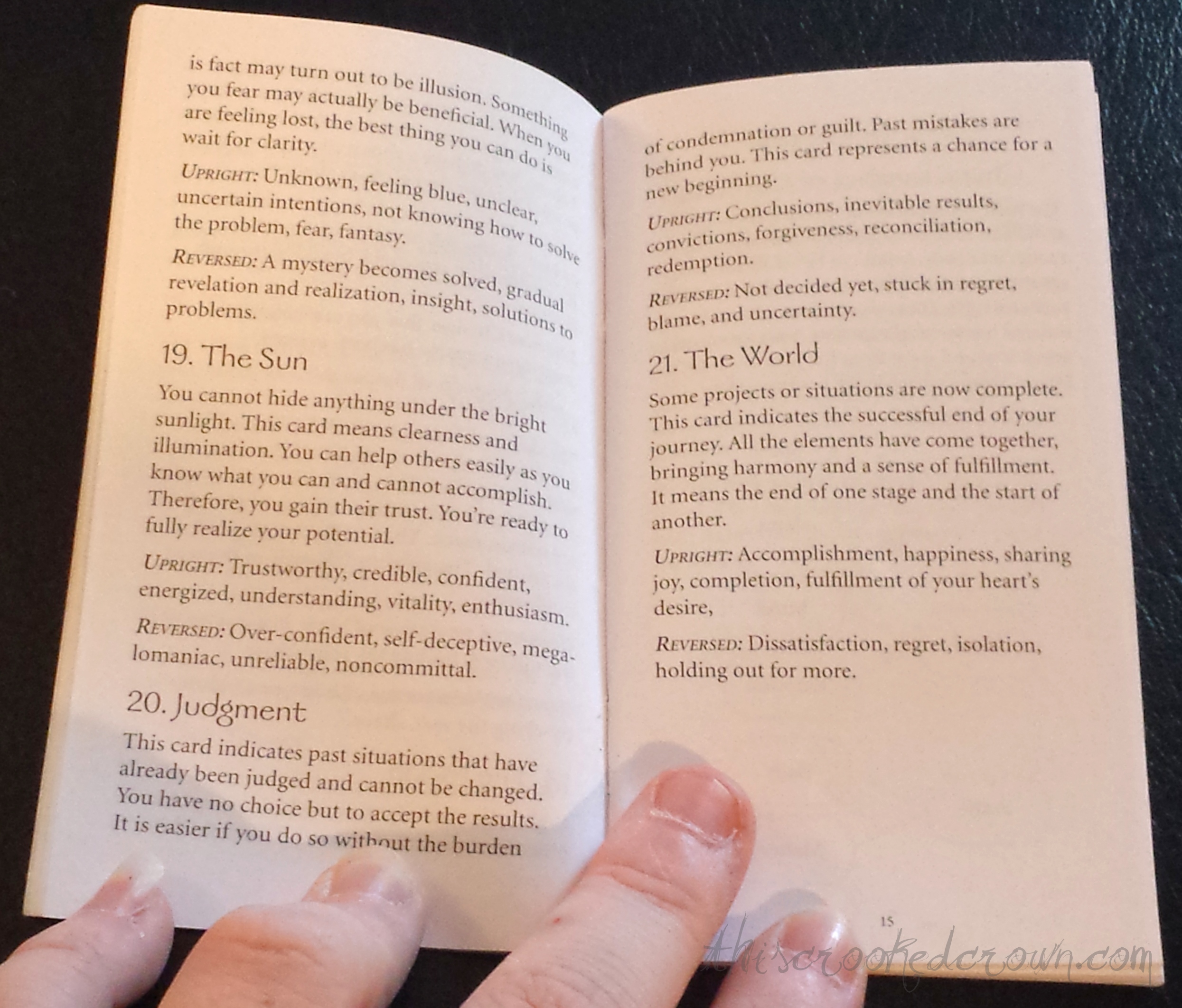
As far as the little white book goes, the Dreaming Way tarot is standard. A little blurb on the card itself plus it’s upright and reverse meaning, if you choose to read that way. I don’t tend to refer to this LWB at all unless I want to understand what a minute detail in the card might be when studying the deck.

One thing that’s worth taking a second to glance through is the introduction to the Minor Arcana. It’s about two pages in that tiny book but I liked the way the ideas there were expressed with the characteristics of the suits as mind, body, and soul.

Dreaming Way Tarot's King of Wands, Magician, Five of Swords, and King of Cups

Dreaming Way Tarot’s King of Wands, Magician, Five of Swords, and King of Cups

The deck reads as a RWS deck but it’s not entirely a carbon copy. There’s some original and smart thinking that went into this deck if you look at the details. Take a look at the King of Wands in the above (kind of blurry) photo. There’s a lizard on his clothing. Wands are generally associated with fire so the link to salamanders is there, ready to be made. The King of Cups (above photo) is also smartly done. A king standing alone awash a sea eyes closed from the dangers around him? Speaks of a man who feels and trusts his feelings despite any mocking or danger that might comes his way from such trust. Even the poses of the characters have meaning. This is mostly true of all decks but it’s showcased in a subtle (and not so subtle in some cases) way here. Of course, that’s just my interpretation but I really like how each card has just a slight difference that makes this deck special.

Fool, Two of Swords, Queen of Wands, High Priestess of the Dreaming Way Tarot

Fool, Two of Swords, Queen of Wands, High Priestess of the Dreaming Way Tarot

This deck reads extremely well. I find it a very intuitive deck that has a lot of offer. Incredibly intimate and emotional (look at all the water references) it has a punch of creativity, movement, and quiet energy in most of the cards. Wands are everywhere in this deck and the intricate backgrounds combined with little details such as the Torah the High Priestess is holding makes the deck worth a second look.

The deck’s great for honest, gentle truths (but it can still throw a mean punch when needed) and is great for introspection and exploring the details of a situation without being smacked over the head with over the top symbolism.

The Dreaming Way Tarot's Devil, Eight of Cups, Lovers, and Page of Wands (another favorite!)

The Dreaming Way Tarot’s Devil, Eight of Cups, Lovers, and Page of Wands (another favorite!)

One thing to notice is that there’s some interesting interpretations of the cards here. I love the Devil here. Instead of a gruesome visage it’s a winged and horned woman wearing a her straight jacket like a cloak holding chained lovers. It speaks more of the chains we create for ourselves rather than a connection to sins which I wholly enjoy in this deck.

The Lovers here is another interested card. Winged beings are shown in the deck, such as the Devil, Temperance, and Judgment card but in those cases the Devil has bat-like wings and Temperance and Judgment have more of the feathery angel wings. But the Lovers is different. Here we have butterfly fae like wings. The birth and change of something that was brewing into something beautiful. There’s a bit of a leap of faith reference in there too with the fae’s closed eyes. It’s very much on purpose and a warm, lovely Lovers’ card. The hard choices that the Lovers’ card is there too though. Notice only sky background. What would happen if one of the potential lovers let go? Would they fall in love or fall out of it? What would that choice do?

Dreaming Way Tarot's Hanging Man, Star, Seven of Cups, and Moon

Dreaming Way Tarot’s Hanged Man, Star, Seven of Cups, and Moon

The Hanged Man and Moon (above) are other great examples of the slightly different interpretation. The Moon has no direct association to water here in the card and instead the spectacles-wearing figure is playing with the Moon’s common card companion, the crustacean. Here, the crab is traded for a lobster. This, to me, plays with the less emotional impact of the Moon cards and more of the confusion and mystery of the card. Looking past the confusion, illusion, and unnecessary fear and seeing the clarity and truth behind it.

The Hanged Man has clothing hangers on the branches. Do you see them? Not only that but notice the figure’s tie is perfectly upright despite the bonds that hold them still be affected by gravity. Here the halting a take a moment of contemplation while at a standstill is clear. Donning off the nonsense and looking at the truth is implied. Beyond this, growth is possible once you work to free yourself and get moving again.

Another set of favorites from the Dreaming Way Tarot.  Four of Swords, Seven of Swords, Page of Cups, Page of Pentacles

Another set of favorites from the Dreaming Way Tarot. Four of Swords, Seven of Swords, Page of Cups, Page of Pentacles

Issues with this deck include a lack of noticeable POC and the fact that the colors don’t show up well in photography. At all. The text on the cards pairs well with the deck but the combination of text and soft color palette seems to mess with camera focus. This is especially true is you have more than one card in the photo.

Overall, I highly recommend the Dreaming Way Tarot if you like introspective decks and the art is pleasing to you. It’s one of my favorites and every time I use it we build a much better rapport. While you can easily jump in and read the deck, it’s definitely worthwhile to spend some time and pick out the differences in the cards and what’s similar to other decks to see how this one reads. It’s a great all purpose deck, especially if you do a lot of soul searching or introspection.


Dreaming Way Tarot by Rome Choi and Kwon Shina © US Games Systems

Introducing Divination Tool Reviews!

I’m really excited to announce this new, on-going series of blog posts! Diviners use all sorts of tools to get their readings from looking up at the sky and watching birds to using a tarot deck. There’s thousands upon thousands of different tools out there, especially in regards to cartomancy methods. A lot of diviners end up with large collections of decks they hoard and adore.

However, not a lot of people actually post about their experiences with various decks or tools and that’s really a shame! Divination tools can be expensive and if you make a purchase and end up not liking it, the tool itself can be hard to rehome. Reviews can make decisions far easier in terms of whether or not a deck will mesh with you personally.

Each deck tool I use is one I personally own and use. This doesn’t mean each and every tool will be the same. My aventurine pendulum won’t be the same as yours due to lots of reasons such as where it was mined, shaped, and sold from. It can all vary and that’s part of the fun! I’m an average consumer in terms of tools, especially since I’m willing to try a bunch of different divination techniques involving a lot of different tools. Some things I’ll make myself and others I’ll shop around or save for. It’s fun and should be fun. Hopefully my reviews help a little.

What will each review include?

Each review post will include images of the tool in question. Physical specifications such as the size of the tool, the material and quality, where it’s purchased from, and a discussion on my experience with the tool itself. Discussions such as art style, feel of the tool, any associated books or items that the object came with, and favorite aspects of the tool.

Each review will then be cataloged in the “Tarot and Oracle Decks” page, as you see linked above. (The page title is something of a misnomer since there’s more than just cartomancy tools in there but shh.) As a bonus, that page will be cleaned up to be more user friendly because it’s kind of ridiculous right now.

Posts will be using the tag #divination tool review and the category Divination Tool Review.

Home Construction, Witchcraft, and You

I’ve lived through a fair amount of construction. You’ll hear that living through construction isn’t fun and they’re right. It’s always a hassle and always difficult to live through. There’s always someone in your home, there is constantly dust and dirt everywhere, entire rooms will be out of commission, things will be misplaced, and worst yet, you have to have pants on or even be presentable at some ungodly hour in the morning. Shudder.

Now long-term readers will know that I live in an in-law flat at my mother’s house. My mother’s house isn’t new. Built in the 1940s, it sits between two crossroads on the top of a hill overlooking a swamp turned middle school. (No, I’m serious.) The previous owner did a lot of work themselves – poorly. The garage was clumsily doubled, we’re fairly certain one of the bedroom’s was added, the finished basement was roughshod, the kitchen linoleum floor was caulked down, the upstairs tub isn’t sealed properly and leaks into my closet at times… oh the list goes on and on. We once watched an electrician climb up a ladder, open up a ceiling light, and then fly back down, shaking their head in fear and horror.

Every single time we attempt something in this house, no matter how small, something expensive and catastrophic happens. A simple clogged kitchen drain turns into the house’s main line being snaked because of the way the plumbing was designed. Adding a ceiling fan becomes rewiring half the house. Changing cable companies requires three teams of people all to stare in vague disbelief at the house. Every single home improvement we do is a major event. Despite the trouble, each year we try to do something for the house. Sometimes those home improvements are laying down new flooring ourselves or updating appliances and other times it’s the more construction side of things. This year it’s windows and gutters. The star of the show is a window that takes up half the wall in the double parlor. We’re turned into into a bow window with a little shelf for plants and knick-knacks cats.

But what does this have to do with witchcraft?

Let me talk to you about windows first. Windows are doors. They are gateways. They are reflective surfaces. They are both outside and inside. They allow you to see the world without being involved with it. Windows are the shit. Glass is pretty damn amazing all things considered and I could do a whole rant on the amazingness of glass but I’ll put it aside for today. Windows, like doors, can be used as entrance ways for spirits and magic, especially if you treat windows as a door. When I cleanse the house I cleanse the windows the exact same way I cleanse the doors and corners. They are spaces where two things are separate by very little, like veils between worlds.

So when mum said “we’re going to do the big window this year” I sighed and thought “well, shit.” This means I had to break down the protections on this huge double window in our living room that we haven’t been able to open for the eleven years we’ve owned the house. So I spent a few evening tearing down the protections and holding them out in a temporary state until the installation could be done. Plus I had to take down the barriers to ensure that any constructors workers that are psychic-inclined don’t get a massive headache from my barriers (known to happen as I do some powerful protections). Then it took several days to ensure that the new window protections meshed well with the old protections. I also cleansed the window and area from any crap it came with during the install.

The room's mostly done in this image. There's still some touch up needed. The wall colors are silver (inset) and a marine turquoise green.

The living room is now a great place to hang out.

And one doesn’t simply add a new window to a room without considering repainting said room. So I did that too. The inset transformed from red into a silver-white and the peach walls melted into a marine turquoise green. The room is now cool and clean feeling. It came out really nice all things considered and now I’m really pleased to say this will be the perfect space to do readings for clients that come to the house. Plus, I was able to install some of my older gaming consoles so it doubles as a joint gaming location for the household. Which makes it even sweeter. It still has some work that needs doing (touch up paint) but usable again which is super nice. The photo to the left is the new room. I just wish I had a before picture to show you the stunning change.

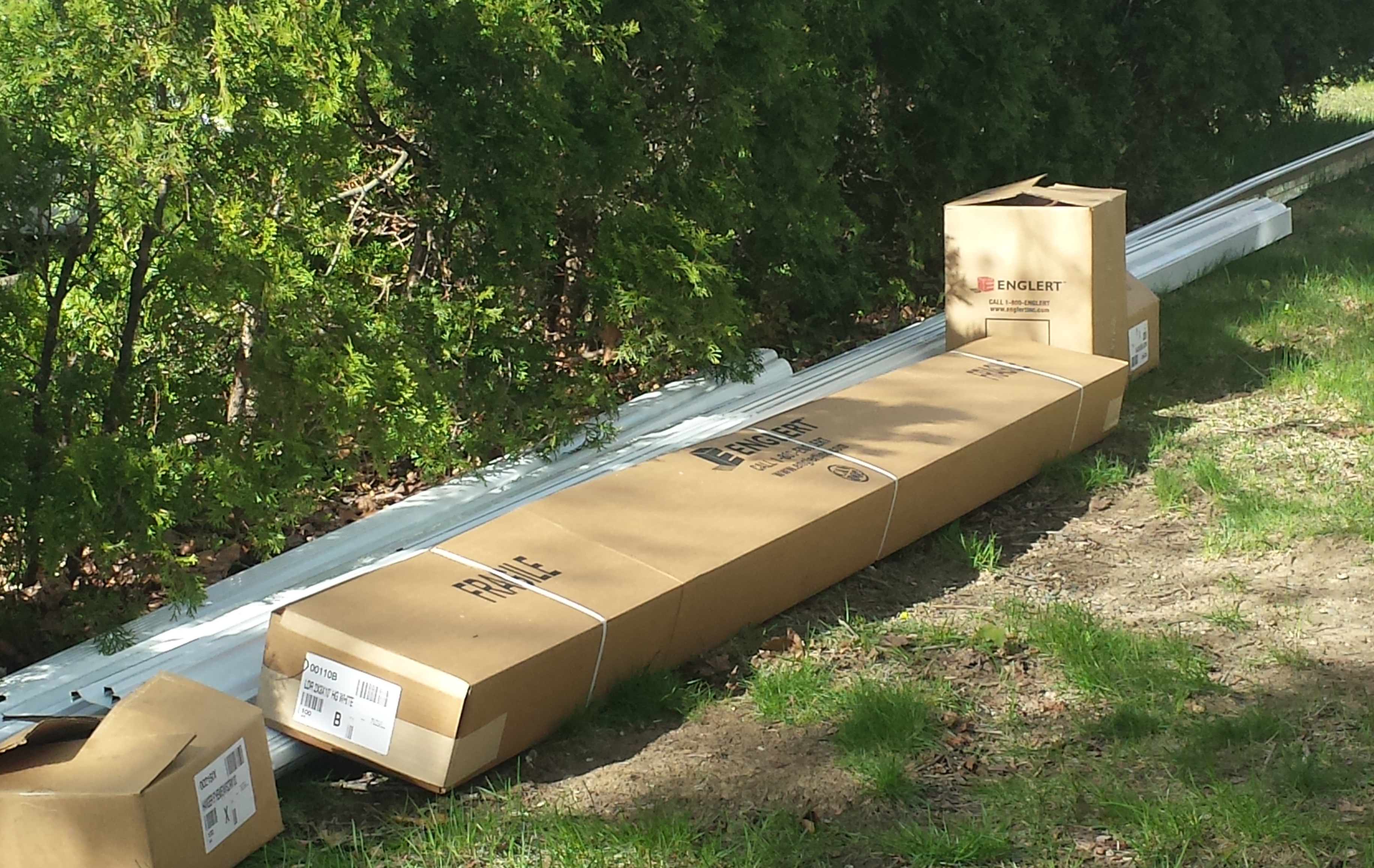
Gutter boxes laying across the side yard and waiting for installation.

Gutter boxes laying across the side yard and waiting for installation. Get use to seeing this and more if you’re doing construction.

Then we turned our attention to the gutters. Actually, the installation of the gutters is being done as I type this, huddled over my computer sipping on too much coffee as the crews started at the lovely time of seven-thirty in the morning. We are not morning people and there was much bitching involved with this wake up call.

Gutters are a pain in the ass. Not only did I need to take down anything hanging on the exterior wall that could fall down, but I had to do some major landscaping and  deal with the fact that my gutters are changing. Gutters are potential streams attached to your house. Water helps conduct of a bunch of things including energy. With new gutters up, I’ll had to ensure the corners where the gutters hang were well protected magically. I had to crawl into the depths of the house to find each corner and protect it. Luckily I didn’t have to climb on the roof but it was a near thing. (I don’t mind climbing roofs but the ground was muddy and ladders don’t do well in the mud.) I did have to dodge some possums that live in our garage attic. We usually stay out of each other’s way but I scared the shit out of them when I climbed up to do the spells. It was worth it as I can now incorporate a potential running source of water into its own self-standing protection during storms and inclement weather.

That wasn’t the only change going on though. When you start doing work on one part of the house, you tend to start looking at the other parts of the house and think “well, that looks like shit. I bet I could change that.” Which is what happened to me.

In order to do the gutters I had to hack down my grape vines and climbing roses off the garage trellis. This is the backyard spring clean up in progress.

In order to do the gutters I had to hack down my grape vines and climbing roses off the garage trellis. This is the backyard spring clean up in progress.

During install

And here’s during install. There was a lot going on. A lot of ladders. Still not done with the yard spring clean up. Sigh.

I already mentioned I had to do some landscaping. When the previous owners built the trellis and planted the grape vines, they also put a gutter on the garage roof (which you can see there in the photo hanging down a bit. I damaged it during my demo). I have three mature grapevines and a climbing rose bush that propagated itself so now there’s something like four of them along that back wall. I kind of let the vines do their thing for years and they were in some dire need of trimming and shaping. So I hacked them all down to what you see in the photo. It was several days of tiring hard work. It wasn’t just cutting them down. I had to cut each vine piece into a size that would fill a lawn bag. I’m already at ten lawn bags as of this writing and I’m sadly not done. I also had to rake out the leaves on the patio and the leaves on the memorial garden on the other side of the garage (my bittersweet nightshade is a monster that will not be tamed). I also had to beat back my Audrey III in the front yard. In the summer we let it the creeping jenny wind around the front porch and provide some serious shade but every few months I have to go out there and hack it down to size. Creeping jenny will go everywhere if you let it so I had to make sure it didn’t make it’s way down to the mailbox. Followers on my instagram saw my work in progress a while back as I tackled Audrey III. It worked out though since I needed to clear out the front anyway so they could put the gutters up on the porch.

I’m still not done yet though. Although the garden’s now coming along nicely and will be pretty damn sweet come the summer, I’m also tackling three more painting jobs. The dining room (actually the second half of the living room since it’s a double parlor) and the greenhouse/storage/exercise room, and my staircase into my apartment are also being painted. (Yellow, green, and multicolored, respectively). I might even do my own kitchen/sitting area too if I still have enough fucks to give by that point…. Yeah. Half a house later and I’m satisfied with the house. Until next year that is.

I know I’m not the only witch to deal with construction so here’s my tips on how to survive, witchy-style. This list will also work for those of you apartment dwellers who have landlords that drop in with a “hey, we’re going to be doing work on your place. Deal with it.”

  1. Be certain you know when they’re coming, going, and to have all your paperwork in order. Put a “notice me!” type spell on paperwork you’ll need (and some pens!) so you can locate it in the chaos to follow.
  2. Secure any breakables, expensive stuff, and well-liked things. Thievery isn’t unheard of. Put down some badass “do not touches” on stuff and some extra protection on things you want safe. Plus thieving spirits will get into everything since your protections will be moved around too.
  3. Get a box and put your witch shit in it. This depends on you but if you’re not out about your craft and you want them to not know of it, get a box and tuck the most damning stuff in it. Stick it in a closet somewhere. Put your altar in a second box by itself. I highly recommend, especially for long-term constructions, moving the altar to a room that won’t be touched or to empty out a drawer somewhere and put the altar in that. If you’re open about your craft and don’t mind people knowing (like me) then just make sure your witchy stuff isn’t going to get knocked over or trip anyone. (I’m looking at you, cauldron).
  4. Cleanse the house before anyone comes in. This gives you a baseline for finding out if anyone’s hauling in new stuff or any negative energy that might come in. Plus it’s nice to have a breather before the chaos. Also, clean. It’ll cut the clean up after the construction in half.
  5. Make sure the new parts of the house mesh well with the old parts of the house. Each house has its own personality and spirit. Some spirits are livelier than others so make sure the house knows what’s going on and what to expect. [UPG]
  6. Determine if your protection spells need to be altered, adjusted, or taken down. My home protections are layers upon layers. Most are designed to be “dropped” at a moment’s notice for reasons I won’t get into here. My household is made up of misanthropic hermit-hobbits so we have excessive protections to ward off… well, everybody. Most people don’t do that apparently so YMMV but you may need to put aside some protections for the mean time. If you do, remember to boost your personal protections and any protection spells for individual people or things that may need it.
  7. Cast a luck spell. Not only will this help things go smoothly but it may speed up the time of the construction or save you money. Do any other necessary spells before construction begins and plan any regular rituals you might hold around the construction if possible. If you do big spells or spells with lots of components, start making those things now and put them aside. (If you use an anointing oil for example, make that before you begin construction)
  8. Find the devices and items you use every day and enchant them with a “notice me!” spell. I do this for all my remotes as well as my cellphone but you might also find it useful for things like medication, toothbrushes, hairbrushes, and so on.
  9. At the end of each construction day, take ten minutes to meditate and de-stress. Your home will be in chaos. Your home’s energy will be tossed around and feeling like crap. Find a corner of your house that is completely untouched by the chaos and go there. This might not be possible depending on the construction but try to find some place where you can have a moment.
  10. Keep your regularly scheduled woo and non-woo stuff on track. Do normal things. This will be one of the hardest things to do but it can be the most encouraging and supportive for you. Make your bed. It doesn’t matter if the entire family’s crashing on a mattress on the floor but the simple act of making the bed look neat will give a visual and mental reprieve from the chaos. Plus, you’ll have somewhere to sit and put stuff that you’ll need to find again in five minutes.
  11. Unfinished houses are in danger from spirits and woo the most. Protect them as much as you can. Try not to leave walls unpainted or spaces without where things can be tucked without your knowledge. Cleansing, divination, and knowing the energy of your place will help find anything amiss. [UPG]
  12. Enchant as you go. I placed charm bags in the walls of my flat when it was rebuilt. I use water or chalk to trace out protection symbols on walls and floors before they were finished. When painting, each coat has a new enchantment on it, depending on what my purpose is. If you’re a DIYer, definitely enchant as you go. Remember that blood is powerful but so is sweat and the energy you put into something.
  13. Determine if you’re setting up a permanent spell, a spell that will need to be maintained, or if it’s something that can be taken down when/if you move. For example, as mentioned many of my house protections can be dropped. Some of those protections are part of the house now and will never be taken down without someone going out of their way to do it intentionally, even if I moved. Layering protections like that can help but adding new bits to your home puts a discrepancy in between the protections. Make sure everything melds together smoothly when needed.
  14. Blessing your new space might be a thing you want to do. I tend to roll it into my protection rites and it’s less of a blessing more of a “Welcome to the Crossroad-Shire! We drink blood on Tuesdays and perform necromancy on Fridays. Pants are optional.” YMMV. (I’m kidding about the blood).
  15. Sweeping out the negative energy with the dust and dirt will be helpful. Expect to do this actively for a week after construction. Dust will be everywhere.

Here’s some non-witchy pro-tips for the construction-minded folks out there:

  • Always have a contingency money set aside in case something goes wrong. I personally recommend and go with half of whatever you’re paying to have done available or on hand. Excessive? Sure. But if you don’t need the money then it can be plopped right into a savings account or spent on something nice.
  • Many window companies will outright refuse to price windows individually or do only a few windows at a time. If you do have a company come out, see if they’re guarantee a price or do some windows at a time.
  • Avoid using companies that don’t do the work themselves. Trust me. You can bitch all you want to the place you ordered your fancy new door from but they won’t give a shit because it’s on the contractor they hired out and that contractor is magically not insured or just poofed from existence.
  • Rhode Island is one of the worst fucking states in the U.S. for construction. Hands down. We’re notorious for it. If you’re in the New England area, triple check any construction companies as they might be from Rhode Island.
  • Make duplicates of your paperwork and keep it ALL in one place. Ideally, this should be the place where all of your important paperwork is kept whether a safe, deposit box, filing cabinet, or a beat up box tucked under your desk.
  • Stock up on foods and drinks you don’t need a kitchen for. Even if your construction doesn’t take place on the same floor as the kitchen you may find yourself so stressed from dealing with the construction or people that you can’t be bothered to cook.
  • Secure your pets and children. This should be incredibly obvious but it needs repeating.
  • Buy an extra set of cables for your devices. There is literally nothing worse than misplacing your charging cable or was finding it in the sink under a pile of soaking dishes. This will invariably happen after the stores are closed in your area and your phone is at 10% battery.
  • Have at least one set of shoes tucked under your sleeping space. Shoes are some of the first things to be misplaced in the chaos of construction. Hide an all-purpose set of shoes in your car for extra protection.

Now, here’s an unpaid promo. I cannot recommend enough Power Home Remodeling Group. They’ve always been polite, clean, and friendly. Always professional, enthusiastic, on time, and on top of their paperwork, they have excellent customer service. Plus the work they’ve done so far has been amazing. They’re the people we’re going through for all our windows, the gutters, and whatever else we can use them for. So if you need windows, doors, or gutters and you’re in their area, I’d use them.