2017 Resolutions, Wishes, & Dreams

Welcome to 2017.

I hope, with absolute sincerity, that your year shapes up beautifully. I hope you will find love of all kinds. I hope you will find passion and courage within your life, to pursue your dreams, your goals, your inspiration. I hope you find a well of strength in yourself to achieve the goals you’ve set and conquer the challenge you’ll be faced. I hope you find, receive, and spread kindness throughout the world. It’s so needed right now and so necessary.


Now that the blessings and my hopes for your 2017 are out of the way, let’s talk about resolutions.

You’re probably in one of three camps when it comes to New Year’s resolutions. You might make and try to achieve the resolutions you’ve set every year. Or you don’t make any resolutions for a variety of reasons. Or you halfheartedly make a resolution and maybe achieve it.

I’ve been in all three camps over the years. This year I wrote a list of things I want to do, in all areas of my life. Some are totally doable things that will happen because they’re already set up to happen. Others require inner strength and determination from me. And a few require luck or spells to occur – if at all. I starred the ones that were really important to me and wrote down WHY I wanted to achieve those goals because when it going gets tough, I’ll remember why I’m doing it. I entitled it “2017 Wishes” because they’re not all resolutions and not everything on that list is a dream. It’s just a list of things I want to happen in 2017.


Be kind to yourself. Make simple goals a part of your new year as well as the big dream goals. Lose that weight but also make it a goal to walk in a park, woods, or beach once a week. Finish that big project but spend some time completing your To Be Read pile. Spend time achieve little goals including big ones. Those little goals can open up so many opportunities within your life and pave the way for the bigger goals you want to achieve.

When it comes to magic, I keep it simple. I write in magical ink on enchanted paper and hang it up by my desk. with iron nails and  blessed string. I pick a quartz crystal, cleanse and let it sit in a window for a full day and night then program it with my wishes for the new year and put it beside my bed.


I find action more useful than magic during these first days so that’s what I do. For example, today January 2nd, I intended to wake up at my regular time, get my workout in, and start accomplishing my to do list. Instead, I woke up at my regular time, then my “get the hell out of bed” time, and went back to sleep until late afternoon. Instead of calling the day a wash and playing a video game, I showered, dressed, and sat down to get the important things done. Because I determine how I want my day and year to go. I want this year to be productive, successful, and kind. So that’s what I’m doing, even if the sun’s already set in the sky. Spells for motivation, luck, and other blessing are great helpers.

Here’s to 2017. May it be wonderful for you and those around you.

P.S. And don’t forget to vote in the poll. It helps me to help you!

A Petition Ritual for the New Year (Spell Saturday #39)

Here’s an complex yet simple ritual for New Year’s. It might requires a few different things but can be used to petition the elements and the world to bring your desires to fruition in the new year.


a-petition-ritual-for-new-years-eve-by-this-crooked-crown


What you’ll need: 

  • A new white candle
  • Clear drinking water
  • A fire or a second lit candle
  • A bit of your hair
  • Seven coins


On a clear night, go outside and create a fire. If you cannot create a fire, you may light a candle from a fireplace, match, or a lighter.

Set up the glass of water, fire source, and white candle in front of you in any manner you’d like. You can create a circle around you or a line in front of you. Whatever you prefer. Dig a hole in the ground and leave it open.

Kneel in the darkness with fire and take a deep breath. Feel free to close your eyes. Clear your mind as much as possible. Focus on letting go of all the negative things of the past and the things you don’t want to take with you moving forward. Take another deep breath and when you’re ready, open your eyes.

Light the candle with your fire source, drink a bit of the water, rub the soil from the hole you’ve dug in your hand, and take another deep breath.

Place the coin inside or under the candle. Put a second coin on the ground, pour a little water over it, and place your water glass over it. Put a third coin in the hole you’ve dug and toss a pinch of soil on it. Toss a fourth coin into the air and let it fall wherever it likes. Repeat the process with a strand of your air. Keep any remaining hair for a later part of the spell.

Now make your petitions for new year. Ask for prosperity, health, happiness, or love. Ask whatever you like. Be as specific or as vague as possible. Be as formal or casual as you’d like. You don’t have to speak aloud, you can just think clearly in your mind. Just say what you need to say and express you hopes for the future. Now demand for your petitions to happen. Tell the world that these things will happen for you.

Once satisfied, toss whatever remaining hair you have with you into the candle. If it goes out, let it. Don’t relight it.


Toss the fifth coin behind you, to pay off any regrets and past debts. Don’t look back at it. Toss the sixth coin in front of you to pay for your future. Pocket the seventh and last coin and carry it for good luck for the year.

Douse your candle and place the remnants in your fire source. If that’s not possible, bury both your fire source and the candle where the fire source was and in a separate hole from the previously dug hole. Pour out the water into the earth and fill in any dug holes. Leave the area without looking at or walking towards the area you threw your past coin in.


Candle Smoke


Notes:

  • This spell was designed for New Year’s. The chill from the cold January night is part of the spell’s sacrifice. that being said, if it’s too cold, snowing, or raining where you live, wait to do this spell until you can stand going outside. Don’t injure yourself to do this spell. Be safe and healthy.
  • This spell was created with a campfire, fire pit, or fireplace in mind. Since that’s not always feasible for everyone, you can substitute it for other fire sources light the stove, matches, or lighters.
  • You don’t need to collect fresh hair for this spell. Just save a clipping from a recent haircut or pull some from your hairbrush. If you don’t have hair on your head, you can use hair fro other areas of your body like your arm, leg, or pubic area. You can use fingernails too, if the hair option doesn’t work for you.
  • Burning hair smells absolutely terrible. Endure it as best you can.
  • If you manage to keep your good luck coin throughout the year, use that coin in next year’s spell as the “past” coin.
  • Tip: to make your good luck coin stand out in your wallet or pocket, you can coat it thinly in wax or create a paper envelope for it.

Happy casting and happy new year!


Thank You! + Poll: What do you want to see in 2017?

spells and herbs


In a few days, 2017 will be here. I’m taking the time today to say thank you to every single one of you who have been following my blog and social media outlets. An especially big thank you to those of you who support my storenvy or etsy shops and eternal thanks for my patrons. Without you, this blog would probably exist but certainly wouldn’t be as much fun or as consistent.

I’ve learned so much this year about running a blog and business and I’ve learned even more about myself. I can’t wait to see what opportunities 2017 brings. It’s definitely been a rough year at times but I always hope for the next year to be better. I do worry about the future, given the state of things in the world right now, but if we all stick together and keep fighting what what we believe is right, for our freedoms and our friends, we can do amazing things together.


I write tons of different posts, as you all well know but what I don’t know is what you actually want to read about. I need your input to make this blog more interesting to you. So what brought you all here? Why did you stay? And what post are the most interesting to you? What keeps you coming back?


You’ve got until Jan. 20th to complete the poll before it closes. You should be able to input your own answers into the poll but if not, drop me an email to let me know if you have specific thoughts. And, of course, as much as I love input and you all, I’m still going to do what I want (I wouldn’t be me otherwise!). But your input definitely matters and helps me create better posts.


Again, thank you so much for such a great 2016. I hope 2017 brings you peace, joy, safety, and security. Much love and many thanks.

-Samantha

This Crooked Crown

Witchcraft Checklist for 2017

2017 is nearly upon us. Are you ready yet? 2016 had been a tough year and I’m betting some of you aren’t enthusiastic for 2017 either. And some of you are so ready for it.

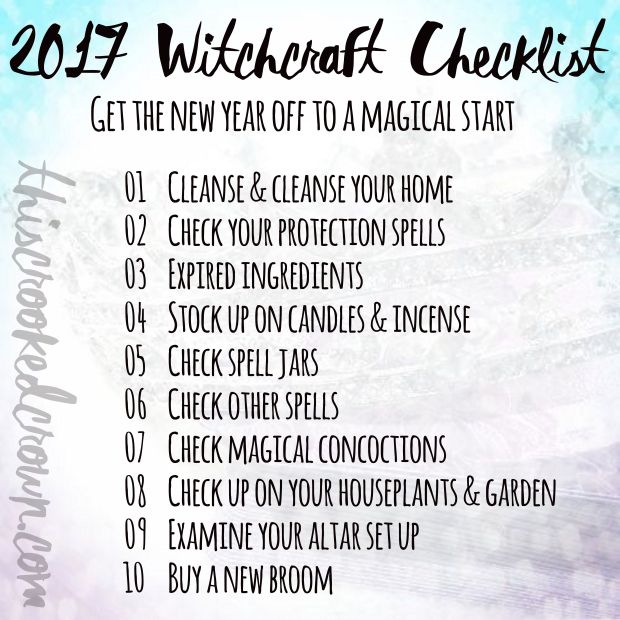
Whatever you’re feeling about the upcoming new year, here’s a list of witchcraft related chores and spells to get you on the right foot in the new year.


2017-witchcraft-checklist-by-this-crooked-crown


01 Cleanse & cleanse your home

This, really, should be the first thing on your to-do list come the new year.

January’s a great time to take part in a big household cleaning. You’ll get rid of all the junk you’ve held onto this long, you can re-home items you no longer want in your life (or holiday gifts you didn’t like), and starts the new year in a clean place. It also makes it far easier to keep up as the year goes on.

If you aren’t combining your cleansing and cleaning spells, you might want to do some. Check out Cleansing & Cleaning 101 for ideas and a how to or this ritual for cleansing.


02 Check your protection spells

Protection spells periodically should be checked, cleansed, and restored. Sometimes spells get worn and don’t protect as well as they should. Now’s a good time to go through your protection spells and cast them again.

It’s also a good time to set up new protection spells. Maybe you missed something in a previous protection spell or maybe circumstances have changed and your spells need to adapt. January’s a good time to do all of that.


03 Toss out expired ingredients

Herbs do expire. If you’re only using your herbs symbolically, then maybe the expiration doesn’t matter but if you also use them herbally or your consume them, you’re going to need to check over your herbs, spices, and other ingredients. Some of them might have become pale, lost flavor, or became moldy.

Many companies will have an expiration date listed on the packaging. Otherwise you might need a google search to give you a hand.

Toss or compost the expired ingredients and buy new ones. Did you discover a jar of herb that you rarely or never touched? Maybe skip buying that until you really need it.

This is also a good time to check any herbs you’ve had left out to dry and process them into a more handy size and bottle them. Remember to sanitize your bottles /jars and let them dry completely before use.


04 Stock up on candles & incense

Sort through your candles, incense, and related goodies. Put aside broken candles for melting down into new candles and make a list of what you’re out of or running low of so you can buy them next time they’re on sale. Remember to check scents, sizes, and colors for this.

Double check your candle holders and see if you have enough holders. Clean out any candle holders that are full of wax. A crappy knife and some oil make getting wax out a bit easier.

You’ll also want to consider putting aside anything you didn’t like using. Maybe a candle never burned properly or the scent of a certain incense was horrible to you. Put them aside and re-home them with another practitioner or friend. Remember to ask online. A lot of people are willing to pay shipping to get an item free and you’ll know it goes to a home that really wants it.

Stock up on lighters, matches, and non-flame candles too. LED lights might not burn stuff but they can be really handy in a pinch with some spells.


05 Check spell jars

Spell jars are some of the easiest forms of magic. Just throw a bunch of ingredients in a jar, seal it up, and call it a day. But, spell jars are also some of the easiest to screw up with.

Spell jars can get moldy if they were wet when the dry components were put in it. Or the wet components molded the jar. Or the ingredients became so noxious you risk yourself if it becomes broken.

Check the spell jars you’ve made. If they’re good, then put them back (or remake them). If they’re no longer needed or have become gross, dismantle them carefully! Use gloves if you have to. Toss the ingredients in the garbage and put the garbage outside. Wash the jar and sanitize it. If you don’t want to keep the jar, recycle it.


06 Check other spells

You might have a dream pillow that’s gone flat or an herbal sachet that no longer smells of anything but you. Time to get rid of them or remake those items.

Considering dismantling and burying all cursing poppets, spells, etc. It’s a new year and maybe it’s time to let that grudge die? If not, renew the curse.


07 Check magical concoctions

If you’re an intermediate or advanced practitioner, you’ve probably got a whole shelf of magical oils or waters you use or make.

Double check them all. They probably need a good shaking and to be topped off. You’ll also want to see if they’ve gone rancid, cloudy, or moldy. Toss what ones are no longer salvagable and re-bottle as needed.


08 Check up on your houseplants and garden

Check your plants. Which ones need re-potting or new soil? What plants need a little help?  Which ones died? This serves as a good reminder to care for your plants and consider how to better care for them in the future. Try not to re-pot anything until the thaw comes around. You’ll risk shocking the plant to death.

Make a list of what you’ll need for the upcoming spring. New soil? Bigger pots? A different type of basil? PH monitor? Making this list will allow you to get a jump on the spring sales when they come around.

This is also around the time that plant catalogs start coming out so planning your garden’s a good idea too.


09 Examine your altar set up

Check over your altar dishes and see if they need to be replaced. Maybe the rim of your glass chalice is chipped or cracked. You might need to save up for a new one so knowing ahead of time before sales pop up is a good thing.

Give your altar statuary a nice bath and/or dust them. Clean the glass and frames of hanging pictures and clear off the altar itself to wipe it down. When you set it up again, maybe place some fresh flowers on it to signal the new year in addition to a slightly larger than average offering.


10 Buy a new broom

Remember to enchant your household broom to cleanse and bring prosperity. Clean out the vacuum cleaner and do the same sorts of spells.


Yule Candle (Spell Saturday #38)

This is called a Yule Candle. It’s a strictly holiday based spell. Traditionally, it’s lit during dinner on Christmas Eve or Christmas Day but this is kind of one of those traditions that’s not based in any particular religion so you an easily adopt it to your own traditions.  So this can be lit during your designated big  winter holiday meal.


yule-candle-by-this-crooked-crown


This is pretty much the easiest candle spell you’ll ever see. Everything is optional. The colors are up to you. It’s comes down to one, singular rule: Light the candle before you sit down to eat and don’t let it go out until you’re done eating. That’s it. That’s the spell.

Following the Yule Candle rule will allow you to avoid bad luck. It’s a pretty adaptable spell so you can do what you like but this spell will combine blessings, safety, prosperity, good luck, and security (enough food, enough rent money, job security, etc.).

I lit mine during my family’s Christmas Day brunch but sometimes I’ll also light it if we don’t go out for dinner on Christmas Eve. Depends on what we’re doing that year. (For reference, my family does a secular gift exchange on Christmas. Religion’s checked at the door for us.) Typically this is lit and left on the table among the family but I like to leave it off to the side or even in the kitchen (within sight of the table) so it doesn’t get knocked over.

What you’ll need:

  • A candle that can last the length of your meal, any color
  • Sturdy, stable candle holder appropriate for the candle size
  • Cinnamon, powdered
  • Clover, diced
  • Clove, powdered
  • Nutmeg, powdered
  • Sage, powdered
  • Rosemary, diced
  • Thyme, diced
  • Ginger, powdered
  • Lavender, crushed and crumbled
  • Rose petals, crumbled
  • Pine needles (optional)
  • Drawing oil or flame


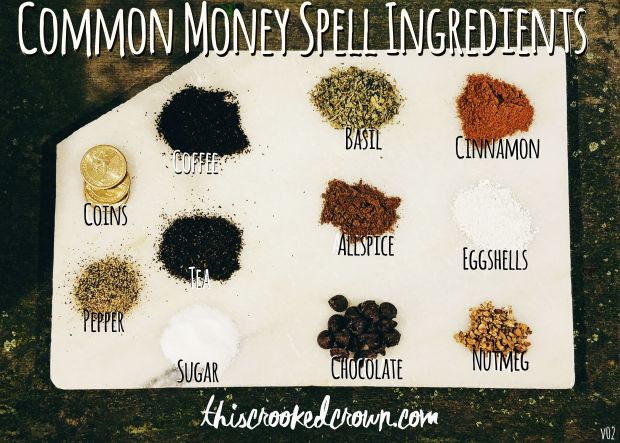
common-money-spell-ingredients-by-this-crooked-crown

Mix your herbs together and spread them out on a plate. Get your candle and make sure to remove any labels for it. You may wish to rough up the sides a bit too with a knife or your fingernails to make the herbs stick better but that’s optional

Coat your candle in drawing oil. You can even use something like vegetable oil or olive oil if you don’t have a designated drawing oil. While the candle is still oily and wet, roll it in the herbs, coating all the sides.

Alternatively, if you want to skip the oil, slowly and carefully heat the sides of the candle up and roll the hot wax in the herbs. This techniques requires more patience and a severe eye for fire safety so you don’t burn yourself but the herbs literally become the candle.

A third option is to melt the candle down, add in the herbs to the melted wax, and pour the wax into a fireproof container or candle mold. Make sure to include the wick and check to see if your newly made candle can fit in any candle holder you own.

Once your candle is dressed, store it in a sunny window or in your kitchen until it’s time for your big holiday meal. Right as people are getting ready to sit down and eat, light the candle. You don’t need to say anything but you can if you wish.

Let the candle burn throughout your entire meal and when everyone has left the table, blow it out. You can discard the candle alongside your meal or holiday decorations or you can save it until next year, using the leftovers to forge a new candle.

Notes:

  • Pillars, tapers, and jar candles are really good for this spell. Large pillars can even be stored in a box or bag and used annually.You can use votive candles, as shown, if your meal isn’t going to be a huge affair.
  • The herb choices here will be largely personal. I have orange zest, ginger peel, and hydrangea petals in my mix for personal reasons. Go with your instincts here. Add dried florals or herbs from your garden or pick a dried herb that screams your holiday to you.
  • Pine needles are included here under the assumption you’re using a holiday tree. If you’re not, skip it.
  • When you blow out the candle will depend on your family. For example, my family doesn’t serve dessert at the main meal – we eat it hours later. But we do sit down and play games after we clear the table from dishes. While we’re clearing the table of dishes, I blow the candle out. Your family’s probably different so trust your instincts here.

Happy casting!

An Exercise for Meditation or Astral Travel

Finding an exercise for mediation or astral travel can be difficult. It will largely depend on your personal preferences for environment and pacing. So while this exercise might work beautifully for your friend, it might not work well for you. Experiment until you find one that works for you.

If you’re looking for an adventure in astral travel, combine this exercise with Myridin’s information.


Close your eyes. Breathe in deeply, slowly, and hold for a moment, then release. Do this several times until you feel your muscles relax.

Picture a forest. The forest is in a valley and you are on top of hill somewhere in the middle of it. The trees are old, tall, and very green. The ground is grass, moss, and packed, dark earth. The air that you breathe in is warm but clean, smelling like sea salt and pine slightly.

In front of you, far into the distance, there’s a tall, cool mountain range. It rises up and clouds cover the top of the mountain. It is too far away to walk to.

Looking to your right, you see that the forest goes on for as far as you can see. To your left are more trees, deep, green, and lush. Behind you are more mountains, chilly and solid. In the very far distance, almost out of sight is a dirt road, leading into the sea of trees.

Above you the sky is a brilliant blue, almost aqua in it’s glory. White fluffy clouds drift by as if asleep.

Breathe in deeply and release. You are safe.

Where to go from here will be up to you. You can wander through the forest and find the road. Or you can hike deeper into the forest or towards the mountain. Or you can sit in the forest and enjoy a moment’s peace. Spend time watching the clouds or wait until night falls and stare at constellations in a star-filled sky you’ve never heard of before. The choice is yours.

When you are ready to return, sit down and close your eyes in your mind. Breathe in slowly, deeply, hold for a moment, and release. Repeat. Now envision the room you are sitting or laying in. Allow time to come back to yourself and focus on your breathing. When ready, open your eyes. You’re done.


Jack Frost nipping at your nose

Or, more properly in my case, causing snow as soon as I step outside.

As blog followers know, I don’t really worship things. Not my cup of tea. But Jack Frost and snow spirits hold a special place in my heart and thus they get a little more attention than your average spirit. Namely, I try.

When the snow began to last week overnight, it was a soft dusting that didn’t survive the dawn. But I knew it had snowed so I brought out the snow related items and went about my day. When I stepped outside to fetch some groceries, a light sprinkling of snowflakes began to fall. Not enough to even be called snowing. It was the middle of the day and was too warm, scientifically speaking, for snow to be falling yet here it was, just for a few minutes, the snow was falling. And Jack Frost was there, waiting anxiously for acknowledgement. So I did what I always do when I spot a spirit: I say hi. He was delighted and danced off to spread his snowy glory elsewhere and I went about hauling in baking supplies.

Jack Frost appears to me as an ageless youth. Often accompanied by a snow maiden or maybe a few smaller snow spirits, he’s usually a fun spirit. Cruelty comes to him quickly though at times and one should be wary of that. I find that children spirits (and his demeanor is often child-like) act this way pretty often and mostly they want attention and affection. Give them both and they’ll add a light-hearted air to your relationship. These spirits, and snow spirits in general, don’t tend to work as some others do. I find they’re not interested in trading tit for tat but instead want the attention because you want to give it to them which is a good match for me.

Because I don’t have a working shrine space (and I don’t want one) when I decide to show a little love to spirits, it takes the place at random and casually; a homemade candle on the table, pressed incense on the counter, a garland along the wall, an offering dish next to the coffee pot. Little bits of witchcraft and spirituality scattered throughout my life.

It’s just something I like to do for our winter wandering spirits. They’re just as important as the spirits of spring so honoring them with a bit of food and drink is something I enjoy doing.

Book Review: When Santa Was A Shaman by Tony van Renterghem – 4/5

When Santa Was A Shaman by Tony van Renterghem – 4/5 – You should be reading this

WARNINGS: None? Olde Religion conflations (but not really?)

The word “Gypsie” is used but refers to the Romani people specifically, supports them as a people, and mentions the oppression they suffer. “Shaman” as a word and concept discussed heavily. Racism and cultural appropriation are discussed heavily throughout the entire review but it’s subject material more than criticism. This book is good for soft polytheists. Hard polytheists like me probably will have a tough time with it.

When I picked up this book at the library, I expected a book describing various myths and stories about Santa and then disassembling and examining them. That’s not what this book is. This book is, without a doubt, a text presenting a singular theory. While written for a larger audience, this book is an academic at heart so plan accordingly. There’s a lot of stuff packed in these pages. I was disappointed that the book was no what I expected – I kept thinking it would suddenly start breaking down Santa Claus myths but it didn’t. Still, it’s a good bit of academic detective work and work a read. Especially if you’re into Herne the Hunter or you’re a soft polytheist or divine archetype believer.

This review is a hot mess and I think that reflects my feelings on this book. Rarely am I so conflicted with a book. Usually, I’m pretty decisive when it comes to these sorts of things. I’m perfectly able to say “I like this book despite X things”. I’m more on the fence about it because I like what the book does but I’m not sold by the theory so I have a hard time with it. This review is scattered, bouncing around with topics, and overall is a mess.


First, let me cover some basic info. I don’t usually review history books. Modern history and comparative religions isn’t actually my cup of tea. Prehistory, folklore, and death rituals were always my area of study. I majoring in archaeology and folklore in college. So I avoid getting into these sorts of discussions because they’re not my forte nor do I want them to be. I am perfectly aware that I do not possess the right kind of background knowledge to have a complete discussion on the origins of Christmas. I don’t have any Christian background so I cannot possibly offer a comparison. I freely admit this. It’s not something I want to study. Other people actually like and know this stuff, so why not let them make informative posts?

Now, I am NOT a fan of comparison religion studies. Or, what I mean is I don’t like seeing deities compared point by point to each other. Like Odin and Jesus being compared. Yes, they are comparable, but they’re not the same entity to me so it irks me to see them compared this way. Like comparing fruits or something. “Hey, you hung on a tree and you hung on a dead tree! You’re the same!” You rarely get actual contrasts with these studies too. I’ll be flat out honest: this is because I’m a hard polytheist.

That being said, I picked up this book on a whim at the library and thought, hey, let’s review it. So here it is. You’ve been warned.

Next, I have so many mixed feelings about this book. At first, I was surprised and liked it, then I was iffy. At some points I was actively unhappy with it., and now I’m back to “ehhhhh, maybe????” In fact, I went through all those emotions in the first chapter. Why? I’m not sure. It’s a mix of reasons.

This book is written by a man from the Neatherlands, who moved to the US and worked as a historical researched for Hollywood before moving back to the Netherlands. (I’ll come back to his origins later) So he’s a historian but not an academic one. Normally, that doesn’t bother me. Getting college degrees is super expensive and taxing so lots of people are experts on stuff but don’t have that piece of paper to prove it. Not a big deal to me. But he’s an actual badass. WWII vet, escaped from Nazi’s after being condemned to death, traveled the world. That kind of badass. I mentioned this specifically because the author does reference his own knowledge and experiences.

This book is also published by Llewellyn which has a not-so-great history of publishing rubbish. It was published in 1995. Additionally, and this is a more personal pet peeve, there aren’t any footnotes. There’s a bibliography but nowhere does it tell you which information came from which book. This is problematic because some of the course material of this book has been discredited or more evidence has come to light. Without footnotes, you can’t weed through which material is still good.

The other issue with older books is that things were adopted via cultural appropriation or there’s some sort of racist undertones of something, that at the time was part of normal society. Don’t mistakes my meaning here – just because something was OK in the 1950s doesn’t mean it was OK then and doesn’t mean it’s OK now. Just because you didn’t know what you were doing is wrong doesn’t mean it isn’t wrong. Live and learn from your mistakes. Try to do better.

Finally, this book uses the word “shaman”. Let me talk about the word “shaman”. It’s a word that originates from the Saami people (BTW, they’re from the same world region as the Neatherlands). It was used by anthropologists as a catch all for primitive magic workers or religious leaders. It should not be used this way. The Saami people are still around and, more importantly, each group of people that “Shaman” is attributed to have their own word for practitioners. Use that word.

There’s also an underlying level of racism attached to the word “shaman”. It rides the line of the “noble savage” trope and “magical savage” trope. Both of which are so racist that it makes my stomach turn. These tropes rely on the idea that “savages” (I.E. anyone NOT a Victorian anthropologist) are uncivilized and White Man has to civilize them – often forcibly and often at the cost of the POC’s original culture. This works with the second trope as well. Because POCs are somehow “lesser” (read: “savages”)  their religions and cultures, especially their magical practices, are more magical. Because they’re less “civilized” and “closer to nature” or some other made up bullshit like that. Which then means that White Man are superior in some way because they’re not as close. Or, the reserve is suggested – the culture in question is spiritually greater because they’re not technically greater (but there’s still generally the idea that the culture lacks something, as a whole).

All of the above said, the word “shaman” is being used in an anthropological sense, not as a catch-all or buzz word. It means a magical practitioner. It means a priests of a culture’s religion. It means a spiritual leader. I’m still not happy with it’s usage but it’s the same unhappiness I have when I read anthropological texts and they use the word. So, I’m not happy but most people wouldn’t see this as an issue at all.

But there’s some weirdness here I can’t quite identify. It reminds me strongly of some of my older anthropology texts, without the overt racism. It’s not quite glorification of paganism either. It’s… I don’t know. Maybe it’s because many ideas are presented as the Sole Source for something and generally speaking, especially with ancient beliefs, there isn’t a singular source. But at the same time, the author doesn’t present everything as a singular source. It’s sort of a “there’s lots of things here and they all don’t have the same origin but the heart of the matter is the same”. He fully acknowledges that cultures help develop religions. There’s a slight bias again Christianity, perhaps, but maybe more of the style of religion that Christianity has rather than Christianity itself.

But, this book doesn’t really specify any specific tradition. It kind of covers the Christmas gambit. It also separates out pagan practices from Christian ones and makes a distinction between Xmas tree and Christmas tree – one being Christian and the other not.

I think part of my dislike comes from the “this is where this ancient idea came from, without a doubt” statements made. It’s a mistake commonly made by writers who want to present ideas to the general population rather than academics – simplify things so readers get the information without realizing that we know relatively little for certain. Read an academic paper and you’ll find a lot of “we believe”, “we think”, “the evidence suggest”, “therefore” scattered throughout. Because there’s probably going to be evidence later on providing either more context or disprove the theory. Scientists are usually OK with saying, “this works, we don’t know why, but let’s run some tests to figure out why” whereas most of the populace just wants concrete answers.

There’s the idea of Olde Religion mentioned. But it’s weird. He fully acknowledges the religions aren’t all the same but he tends to group all pagans together. Which, you know, isn’t right. I think he’s aiming for soft polytheism and archetypes with this idea rather than saying all pagan religions everywhere are the same or are one religion. But “the pagans” is a term used freely throughout the book and I’m not sure if it’s intended to be a way to talk about those who worshiped pagan religions or a united people under one pagan religion. I think the Olde Religion refers to the local pagan religion but it’s not explicitly stated to mean that so… I don’t know. I think my conflict would be resolved if the author simply wrote “Olde Religions”. Adding that plural ending would have made all the difference to me.

This comes apparent when he discusses in brief major cultures like the Celtic. The Celts weren’t really a wholly united people (neither were the Norse until much later) so by his own presented logic there’s going to be differences in religion. And there were. Regionalization of religion, even the same religion, is definitely a thing. Not often acknowledged but it’s a reality we have to face.  But when discussing the Greco-Roman he says Herne is now Pan and that’s just… ugh. What? There’s a LOT of research on Greece and Roman religions (which aren’t the same) and while there is some mixing among the cultures you can’t just say one god is the other – unless you’re going with soft polytheism and an archetype belief. Which is fine (not my thing but I get it). It’s just presented in a weird way.

Herne the Hunter is presented as a major figure and the source of Santa. I do see the connection but let’s cover some real talk here. Herne the Hunter is first written of in Shakespeare’s The Merry Wives of Windsor as a spirit that haunts Windsor forest. (The author states the Shakespeare connection himself). Given he probably existed as a oral legend previously, he’s still not this hugely ancient figure. He’s certainly not universal. He’s a folk legend from England. But he was popular, especially with the Victorians. He’s linked to a crapton of other deities though – Cernunnos, Odin, Pan, and so on. Pretty much any horned deity. Let me be clear. I have no problem with Herne being considered a deity or being worshiped as a deity. I have no issues with him being an archetype or an epithet of another deity. I have minor issues with Herne being presented as a individual ancient deity because the evidence doesn’t support that. So when the author uses Herne the Hunter as his base for a horned deity, it makes me frown unhappily. It fits with the soft polytheism ideaology being presented though.  (BTW, Gaia isn’t mentioned to the same extent as Herne the Hunter but the author kind of presents her as a general archetype too and I make frowny faces at that as well).


Sexuality is handled in an interesting way in the book. The author goes out of his way to state that he uses the term man as a universal general term rather than devoting everything immediately to the masculine. But he does it to avoid the awkward he/she. In the rendition about the discovery of fire (page 8), it was a young woman who touched it first before dancing with it then presenting it to the eldest male. Though afraid, the eldest male was not “to be outdone by a mere girl” and that prompted him to utilize the fire. Then the two of them had sex because fire is sexy. Like any study of culture and religion, sex is discussed in terms of symbolism and so on.

As a side note, the information on STDs isn’t fully accurate. It’s mentioned in a single paragraph on page 66. Syphilis, for example has origins of around Columbus’ time and the origins might go back further, being conflated with cases of leprosy. New evidence suggests even older origins, if I recall my readings right. In historical context, some group it along with smallpox and the bubonic plague in terms of deaths. There’s lots of misinformation on sex out there. Let’s not spread any more of it, OK? OK.

Fire is a repeating theme in the book and is covered consistently. Through fire, the importance of plants were examined (since you burn wood and plants to create fire)

As to the subject matter itself? I think most readers who have done research on the origins of Christmas (or read posts and/or rants on the subject) will be aware of a some of the knowledge. I think. The information isn’t basic or everyday knowledge but if you’re interested in the subject, you’ll probably be aware of a good portion of the material. Some of the specific rituals and tidbits of knowledge are more obscure. The author dug into a lot of academic sources so sometimes the material may seem a bit dense to a casual reader. But anthropology is my field of study so maybe I’m bias?

Anyway, part one covers the history of Christmas in general. Part two actually talks about Santa. Kind of. I picked up the book because of the potential for study on Santa (who is something of a god-hero for me). Santa is presented here as having origins of the Shaman and here specifically but that isn’t explicitly stated until page 93.

Once we do start digging into Santa himself, it gets to the meet of things. There’s a breakdown of various Santa Claus like figures across the world. But the chapter ended far too quickly for my liking. The library copy of the book has a delightful foldout for “The Family Tree of Santa Claus” breaking down various related individuals to the Santa Claus myth.

The later chapters follow the fictional story of Bjorn which illustrates much of what was being previously discussed. A lengthy conclusion wraps everything up nicely. I quite liked the commentary on magic, as a definition. The conclusion is a commentary. It summarizes things and goes more into personal beliefs of the author.

The rest of the book consists of a glossary, bibliography, index, credits, and so on.

Overall, this book read more like an academic text written for a wider audience. It wouldn’t be out of place in an anthropology class as topical reading. It’s definitely something of interest to read if you’re looking for a more academic text without digging through academic papers. That being said, be aware that academic texts present ideas and theories to an audience. They are suppose to present a theory that follows the evidence at hand. That’s what this book is doing.

Is it a text looking at folklore and stories of Santa Claus and examining them? No. That’s what I expected and that’s definitely not what I got. That being said, this book wasn’t a waste of time and offered a great deal of information and insight into this theory. I liked the book and I do recommend it if you want a more academic reading about the origins of Christmas and winter rituals.

If you’ve stuck with me this far, I’m SUPER impressed.  This review was probably a bit tough and technical to get through. Gold star for you!

Foundations of a Happy Home Bottle Spell (Spell Saturday #37)


This spell’s intent is to bring happiness to your home and house all year round. It’s what I call a cornerstone witch bottle. My definition of this is a witch bottle can be temporary – like to draw new friends or lovers –  but a cornerstone witch bottle has the intent to permanent work it’s magic. You’ll touch it up and return it to it’s place, like the cornerstone of a house. If you move, you will leave the bottle there.

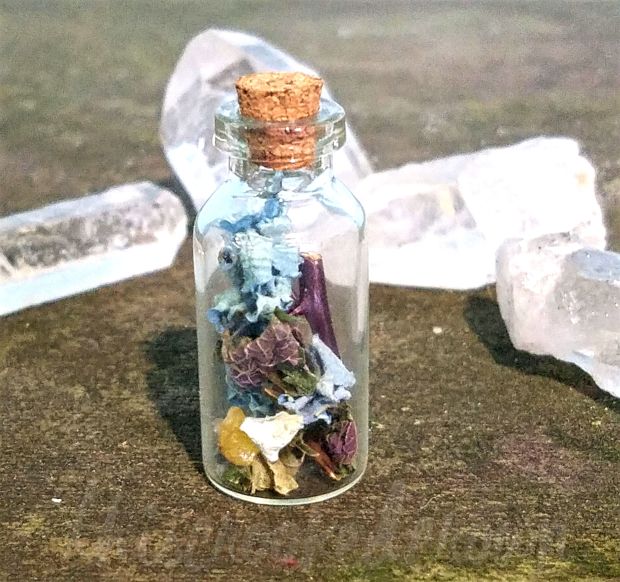
foundation-of-a-happy-home-bottle-spell

You’ll need:

  • Dirt or dust from the four corners of your property or home.
  • Bottle or jar (any kind)
  • Calendar of some kind
  • Dried citrus rinds
  • Dried flower petals, preferably in yellow, orange, light pink, or other bright cheerful colors
  • Sand
  • Rice (any kind)
  • Flour (any kind)
  • Quartz crystal small enough to fit into the bottle
  • Wishes for happiness (optional)


First, gather dust or dirt from the four corners of your property. If you home has wonky corners or edges, go ahead and collect some dirt or dust from there too. It doesn’t have to be much.

Fill a small to medium sized jar halfway with sand, rice, and flour. I’d recommend using less flour than rice or sand. Now add in your dirt or dust. Then the quartz crystal, citrus rings, and flower petals.

If you have something specific that you want to brig happiness to your household that year, write it on a piece of paper and include it in the jar as well. This wish could be something like “I want us to be safe and secure” or it could be “I wish for more joyful laughter in our house”.


Seal up the jar. You can just twist the cap tightly or use a wax or tape seal. Up to you. Remember that you will need to open this jar again so don’t be too aggressive with it.

Bury the bottle somewhere memorable but as close to the foundations as possible. Under the steps, in a flower pot, under the third zinnia. Whatever. You get the idea. Somewhere close to the base of the house. If you live in an apartment, you can totally do this too. Leave the jar in the back of a bookcase or shoe rack near the front door. Whatever you select, it should be as close to the ground as possible.

Mark the date. Make it a reoccurring google date on the computer, set it up on your phone, circle it in red on your calendar.

In a year, dig it up, pull everything out, and bury all of it except the quartz crystal. Was and cleanse the quartz crystal. Let it dry completely and repeat the spell, using the same bottle and same quartz crystal. Repeat annually for best results.

Note:

  • You can absolutely use plastic jars or bottles for this spell.


Happy casting!

One of the Best Sacred Offerings: Charity

One of the best offerings to make to, well, anyone is charity. Donating to charity in your deity’s names is wonderful. Not only is it a perfectly acceptable offering for a great very many beings but you’re also helping out as well.


Think outside of the box when it comes to your donations and charity! You can donate to a beekeeping association to honor a deity of agriculture. Volunteer at a women’s shelter for an offering to a goddess. Those beings associated with health and healing probably will enjoy an offering of volunteer work with the homeless or LBGTQIA groups. Helping out the elderly could work beautifully as an ancestral offering. Worship animals or nature? Donate to a shelter or organize that support them!


You can do other things too. Business owner? You can donate some of your proceeds or products to charity. I offer up healing salves and tarot card readings where the proceeds directly go to a local charity. Do you knit or sew for charity? You can enchant that too for safety and warmth. I also routinely help clean the beach and parks because those places tend to get forgotten in the winter time. And that, too, is an offering.

There’s lots of things you can do to help others and use that act as a sacred act for your own deities. People say this is the season of giving, so why not give an offering or magic?